Beer Trends: Women Drinking Beer

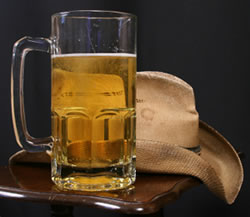
Many men consider the world of beer to be a masculine realm, and these many men are increasingly more mistaken.  With the variety and taste sensations offered by the golden age of microbrew, many women are becoming more acquainted with the pleasures of drinking beer.  In addition to the trend of women increasingly drinking beer, some medical studies have shown that, for women, drinking moderately can help fight high blood pressure and cholesterol.

Woman Drinking Beer

Although the beer market is still mostly a male demographic, beer analysts are realizing that up to 30 percent of the market is actually made up of female beer drinkers.  As of 2005, London based research firm Datamonitor has reported that low carb and light beers are driving greater beer consumption in U.S. women.  Some beer companies have even launched specific lines of beer to appeal to women, such as Heineken’s new malt cider Charli, and Poland’s Karmi.  Beer advertisers are noticing this trend as well.  A 30 percent market share cannot be ignored, and the public has already seen a shift in the content of beer ads.

Women are also drinking a lot of micro brewed beer.  According to a National Restaurant Association survey, about half of women are ordering microbrews when eating out.  Microbrewers must be even more aware of this trend in beer than industrial brewers.
 
For some women, it has been clinically proven that moderate drinking can have health benefits.  Two studies published by the Archives of Internal Medicine and the American Journal of Clinical Nutrition support this claim in different ways.  The first study found that younger women who drink an average of two to three alcoholic beverages weekly have a lower risk of having high blood pressure than those who do not drink.  This study used 70,000 women aged between 25 and 42 years old.  The study tracked the women’s health from 1989 until 2002, and found that women had a 14 percent less chance of having high blood pressure problems. 

The second study, the one published by the American Journal of Clinical Nutrition, focused on older women, 51 of them, who were aged above 60 years old.  The women’s diets were all strictly controlled. This study found that alcohol could lower cholesterol, but only if only one or two drinks were taken in a day.  The women were given strict dietary plans, including either a zero, one, or two-drink quota per day.  The health benefits showed up for the single drink group, but dropped off for the two-drink group.

With studies like these enhancing the trends already present in the category of women drinking beer, we can see that it is only more likely that this trend will continue.

But one Canadian study showed some slightly dismaying aspect for women drinking beer: "My study suggests that sober women who drink alcohol are less able to perceive facial symmetry when sober," said Dr Kirsten Oinonen, Dr. at Lakehead University in Canada,

"When sober, these women are worse at judging facial symmetry, and therefore may find less attractive men more attractive. Given that symmetry is associated with attractiveness of faces, my study does suggest the possibility that alcohol intoxication may decrease facial symmetry perception, and make people look more attractive."


It seems that scientists in Canada have found the technical term for the curious phenomenon commonly known as "beer goggles".
9 Beer And Cheese Pairings

Beer and Cheese Pairing

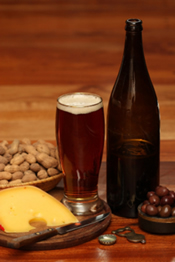
Cheese has traditionally been paired with wine, fruits, nuts or things like marinated olives, but recently with rise of Craft Beer in America we have been noticing more and more brew pubs and bars offering beer and cheese pairings. These beer and cheese pairings include high end cheeses and craft beers that can compliment each other in a new way. Anything from Goat to Gouda cheese and Wit to Wheat beers, it’s all fair game in the new playing field of beer and cheese pairing.

The following are 9 beer and cheese pairings that will excite your palate and bring forward flavors in the beer and cheese you probably have never tasted before.

Beer and Cheese Pairings

Vella Dry Jack
The Vella Cheese Company of California created this cheese by taking Monteray Jack and aging it another 7-10 months, until it hardened. The result is a firm, pale yellow cheese with a sweet nutty flavor.

Pairs well with: Stout, porter, dopplebock, strong ale, brown ale, Oktoberfest

Manchego, 3 mo.
This Spanish sheep’s milk cheese has a milder flavor and softer texture than older versions. A good blend of salty and nutty flavors, sweet hints, and buttery taste.

Pairs well with: Blonde ale, witbier, wheat beer

Danish Blue Cheese
A sharp and spicy, full-flavored blue with a dry texture and dark blue-green veining.

Pairs well with: Stout (especially imperial), porter, IPA, barleywine, strong or old ale

White Cheddar, 3 yr.
Made from raw milk and aged for 3 years, white cheddar has a sharp, robust, tangy flavor.

Pairs well with: IPA, stout, pale ale, amber ale

Smoked Gouda
Similiar to Edam except that it contains more milkfat, this cheese is sweet and smoky on the tongue. The edible brown rind is an indication that it is smoked.

Pairs well with: Amber ale, rye ale, brown ale, Oktoberfest, IPA, Vienna lager, porter

Traditional Hoop Cheddar
A mild yellow cheddar (best are from Wisconsin)made in the traditional way by hand-packing fresh cheddar curds into wheels and aging in red wax.

Pairs well with: Pale ale, any Belgian ale, strong ale, ESB, pilsner, dopplebock

French Brie
A soft cow’s milk cheese with a distinctive rich, creamy flavor.

Pairs well with: wheat beer, tripel, kolsh, witbier/white ale, blonde ale, pilsner

Cotswold
This is a full-flavored, creamy, whole milk cheese, similiar to cheddar, to which chopped onions and chives have been added. It is golden yellow to orange in color.

Pairs well with: Rye ale, kolsh, blonde ale, IPA, stout, amber ale, pale ale

Laura Chenel Chèvre
A classic American goat cheese with a clean fresh taste, more dry than tangy, and a bit crumbly.

Pairs well with: Kolsh, witbier, wheat beer, brown ale, ESB

Bohemian Black vs. Blackened Voodoo

A Comparative Analysis of Black Lagers

Lagers are clearly one of, if not THE most popular beer style in the world. Lagers have become popular enough that many sub varieties have developed. Around the world, you will find beer fans that prefer their favorite style, be that the American-style lager, the Bock, the Dunkel, the Helles, Märzen, Pilsner, Schwarzbier, or Vienna lager. Of the lagers commercially available, I have always preferred the darker varieties including the Bock, Dunkel, and especially Schwarzbier, or black lager in United States parlance. Here I’ll take you through a tasty comparison of my two favorite commercially produced black lagers, or Schwartzbiers, Dixie Brewing Company’s Blackened Voodoo Lager and Shiner’s Bohemian Black Lager.

Black Lagers

Dixie Brewing Company’s Blackened Voodoo Lager was a rare treat I enjoyed with falafel dinners when I was living in Berkeley, CA. This lager was a long way from it’s home brewery in New Orleans, LA, and didn’t suffer from it. It was even more rare after Hurricane Katrina hit New Orleans hard, but now Dixie brewing company is back at it, although the company has subcontracted out some of its brews while recovering and rebuilding from Katrina.

The Blackened Voodoo lager is light and crisp, with a distinct flavor of the chocolaty elements of its dark-roasted barley malts. The hops add what I would call a medium bittering element to the beer, with subtly musky flavorful aftertastes that arise from the mix of the dark roasted malts and the hops mingling. The hops used in this beer’s production are Mt. Hood and Cascade hops. The yeast flavor is very sublte in this beer, just adding the slightest of fruity accents on the aftertaste, which I consider to be a mark of patience in brewing and proper lagering. The body qualifies as on the heavier side of the medium range, which to me seems a bit light for a black lager. 

For some reason, I always find myself remembering how well this beer went with the Mediterranean food that accompanied my first experience with it. The Blackened Voodoo lager was especially effective at clearing the palate with its somewhat dry yet solid flavors and crisp carbonation. The alcohol level is 4.7%, a level at which the taste of the alcohol is easily overcome by the flavorful nature of the brew. A fine brew to cool off with after a long days work in the hot sun (or even the hot shade, in Louisiana!).

Shiner’s Bohemian Black is a fairly recent addition onto the Texas beer scene, and a welcome one. Shiner’s Bohemian Black was originally a limited edition produced in honor of the Spoetzl Brewery’s 97th anniversary, but it’s popularity earned it a continued production run as a permanent part of the Shiner line of beers in 2007. This Black lager is very refreshing on a hot day, much like the Blackened Voodoo Lager. Shiner’s Schwarzbier has a sweeter taste, even with it’s slightly elevated alcohol level (4.9%). The darkly roasted grains seem to impart more body into the Bohemian Black without so much of the chocolaty taste that I found in the Blackened Voodoo Lager. The hop character, once again, seems meant to embolden the bitter aspects of the malts rather than hit you over the head with hoppy dankness. I would call the Bohemian Black a smoother lager, with more body than the Blackened Voodoo. Less carbonation is evident in this beer as well.

One aspect of the Bohemian Black which is clearly enhanced over the Blackened Voodoo Lager is consistency. I have never heard of a complaint about the Bohemian Black, but it seems that the Blackened Voodoo Lager can have some variety regarding carbonation and flavor. My guess would be that the lager may be subject to alteration depending on temperature changes. Also, with the advent of hurricane Katrina, the Dixie Brewing Company has contracted out some of their brewing, including Blackened Voodoo Lager, to Minhaus Craft Brewery of Wisconsin. This might cause some problems, as the new brewery must adjust its apparatus to attain the same results as the New Orleans brewery.

If you are a lager fan, I recommend trying both for yourself. Shiner’s Bohemian Black will most likely be much easier to find. If you should stumble upon the Blackened Voodoo Lager, you should definitely pick up a six pack, because you never know where or when you might see it next!

Beer of Fire: When Barley and Peppers Mix

With the advent of the golden age of microbrews, we are constantly seeing new and inventive beers. One of these beer combinations is the mixture of beer with peppers, especially Chipotle chilis. Rogue brewery’s Mexicali or Chipotle beer, and Cave Creek’s Chili Beer are two examples of commercially produced “beers of fire”. Looking online, you can see that home brewers have been eager to take up the challenge of brewing with Chipotle and other peppers, peppering discussion forums with chat and recipes for beer of fire. Here is a new frontier for beer brewers around the world.

Beer of Fire

The best of the new chili beers that is commercially available, in my opinion, is Rogue brewery’s concoction. A delightful spiciness is added onto an already solid beer. This is the perfect example of a well crafted beer of fire. The beer was originally called Mexicali, but now the name is the more descriptive Chipotle Beer. The base of the beer is Rogue’s Amber Ale. The Amber Ale comes out a rich amber color with a medium amount of carbonation. The flavor normally has a nice maltiness to it, somewhat sweet, but in the Chipotle beer, the malt and hop flavors seem subdued. The result is your ability to really taste the Chipotle as the smoky flavor of the pepper mixes with the flavors of the malt.

Rogue’s Chipotle beer was inspired and remains dedicated to Spanish author Juan de la Cueva. La Cueva wrote in 1575 of a Mexican dish that combined seedless chipotles with beer. Rogue recommends a tasty combination on their website: blend the Chipotle beer with Rogue Chocolate Stout to create a Mole black and tan!

Cave Creek’s Chili Beer is a far lighter offering from the state of Arizona. This beer is the invention of “Crazy Ed” who claims his inspiration comes from being annoyed by yuppies. According to Cave Creek’s website:

“…in 1989, he started brewing his own beer. The town was suspicious. And became even more so when an entire brewery arrived in crates at the foot of Black Mountain, along with a German named Arnold. But after the first batch the people began to come around. The beer was good, damn good, So good in fact, the yuppies started driving in from all over to try it.  Something had to be done, So , whenever one of them whined for a "wedge of lime" Ed started putting a hot Serrano chili pepper into the beer instead. Amazingly, about 2 out of ten actually liked the stuff.”

Cave Creek’s Chili Beer is made in the small town of Tecate, Mexico, where it seems that Crazy Ed and his pals drop a jalapeno into a beer bottle and then fill it with “a fine Mexican lager beer”. The way the wording is displayed, I wonder if it is the same beer that Crazy Ed used to make….

One place where beer with chilis is not new is Mexico. For a long time, beer fans in Mexico have enjoyed a beer cocktail called the michelada. This is another way to enjoy the mix of barley and peppers. Lime juice and chili powder are added to a regular beer of your choosing to make the michelada. If you have been wondering about micheladas, and the new beers coming out with lime juice or chili and lime, now you know! Although brewing with chilis has been a successful prospect so far, I hazard to state that fresh lime juice must surpass any manufactured lime juice substitute that may be coming out in beers like Miller’s Lime and Salt beer and Anheiser-Busch’s Lime flavored beer.

BREW YOUR OWN

  1. For the home brewer interested in experimenting with Chipotle beer, I recommend first brewing a fine chocolate stout.
  2. After racking, take the stout and fill three one gallon jars halfway with your stout.!
  3. Now, prepare your chipotles. You should put them into a strainer, be sure to remove the seeds (the spiciest part), and pour boiling water over them to soften them up and sanitize them a little. Add one, two, and three chipotles to the three separate bottles.!
  4. After two weeks, strain out the peppers, bottle, and label.!
  5. You now have one, two, and three pepper rating Chipotle Chocolate Stout! See how much spice you can handle!

Kegerators.com's Top 5 Names in Domestic Beer

The U.S. beer industry is in a constant state of flux. New ideas and innovations are changing the face of beer every year, especially in the micro brew market. As the primary field of growth in the brewing industry, kegerators.com will name the top ten names in domestic craft beer production. These are names to look out for. These are brewers associated with quality, ingenuity, tradition, social responsibility, and most of all, good tasting beer. For these qualities, we name New Belgium Brewing Company (Fort Collins, Colorado), Dogfish Head Brewing Company (Rehoboth Beach, Delaware), Spoetzl Brewery (Shiner, Texas), Rogue Ales (Newport, Oregon) and St. Arnolds Brewery (Houston, Texas).

New Belgium Brewery New Belgium Brewery of Fort Collin, Colorado, is here honored for the company’s integrity, ingenuity, and the amazing quality of its high production level brewery. A forward thinking, 100% green company which shares its profits with its workers, New Belgium has consistently contributed innovative brewery techniques, while at the same time maintaining ancient and venerated beer traditions, such as its 1554 Enlightened Black Ale. Kudos to the first beer company to recycle its waste grain and harvest methane from it! This full circle renewable energy source now contributes 30% of the energy required to produce over 450,000 barrels of beer annually.

Dogfish Head Brewing Company Dogfish Head Brewing Company, a smaller brewer located in Rehoboth Beach, Delaware, is here honored for ingenuity and fearless experimentation in the realm of brewing. These brewers have gone where few dare to go, preparing beers of up to 18% A.P.V.! Using admixtures such as raspberries, raisins, blueberries, chicory, and coffee, Dogfish Head has prepared some mighty interesting and mighty tasty concoctions. Brewers of the Midas Touch, Dogfish Head has even created a facsimile of a brew scientists discovered only traces of on urns in King Midas’ tomb. A true blend of tradition and experimentation. But you’ll have to go to Delaware to sample some of their latest innovations: small scale craft spirits!

Spoetzl Brewery, of Shiner Spoetzl Brewery, of Shiner, Texas, is a middle-sized brewery (much bigger than a microbrewery at 300,000+ barrels per year) that has, just in recent years, ventured into the craft beer market. Spoetzl is here honored for returning to the craft beer traditions from the precipice of the homogenized U.S. beer fad. For many years, the Spoetzl Brewery kept mainly their Shiner beer going, but now has distribution for many craft beers, in addition to their rather main-stream tasting Shiner and Shiner light. All of this is, in part, to Shiner’s centennial beer program, which started in 2005. The centennial program began producing one special edition beer in small batches at the end of each quarter. With this foray into the realm of experimentation, the brewers at the Spoetzl Brewery found flavors that were received quite favorably. Spoetzl’s Shiner 96 Märzen Ale, Shiner 97 Bohemian Black Lager, Shiner 98 Bavarian Style Amber, and Shiner 99 Munich Style Helles Lager, are all high quality craft beers worthy of recognition along-side the best microbrews of the day.

Rogue Ales Rogue Ales, of Newport, Oregon is a brewery which has maintained an exacting level of perfection with its recipes while keeping an open mind toward new innovations in brewing. With brews as diverse as Soba, Hazelnut Brown Nectar, and the Juniper Pale Ale, Rogue has demonstrated it’s willingness to live up to its namesake. Yet still, for all this invention, Rogue beers are remarkably reliable – one bottle will always taste like the next, even with such extreme different flavors. Here’s another great thing about Rogue Ales: they are all without preservatives or pasteurization.

Saint Arnold Brewing Company Saint Arnold Brewing Company, of Houston, Texas, is here honored for their dedication to serving their community with traditional, well made craft beers. You may not have heard of St. Arnolds unless you have visited central or east Texas. This is because St. Arnolds is more devoted to serving their immediate community than they are in expanding their distribution. St. Arnolds certainly stands a part from the other breweries in this list, being a straight-forward craft brewery with an honorable dedication to traditional beer styles. St. Arnolds has had quite a time dealing with the destruction of Hurricane Ike, but they are moving into a new location and will surely be up and running again soon.

These have been Kegerators.com‘s five most distinguished domestic brewers of 2008.

Beer and Oysters: Sea foods and Their Malty Counterparts

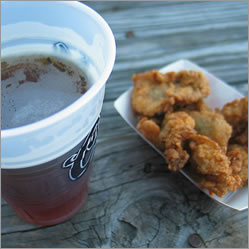
Beer and Oysters go great together.  Beer is commonly served with seafood of all sorts.  The key to enjoying your seafood dinner is finding just the right beer to enjoy with it.   From fish and chips to sushi to raw or fried oysters, complimentary flavors can be found.  The culinary joys of beer and seafood are celebrated in festivals, such as Richmond, Virginia’s "River City Beer & Seafood Festival"; recipes, such as Oysters boiled in beer, beer-battered fish; and cultural traditions from seaside villages all over the world.

Beer And OystersMany kinds of beer work well with oysters.  Porter, Stout, IPA.  Strong flavors work well to cleanse the palate in between bites so that the fishiness of the oysters is not overwhelming.  A good, clean break in between bites is highly desirable.  In regions where beer choice is limited, beer is still preferable to non-alcoholic drinks.  For raw sea foods, a hard liquor is helpful for keeping any rouge bacteria in check.  Tequila and Sake shots especially, although please don’t mix.

If you are talking about grilled fish, grilled salmon, mussels, prawns, your best bet for a complimentary beer is a dark beer.  Porter, Schwarzbier, Stout, all go well in this setting.  I recommend the black lager especially for enjoying beer and oysters a hot or warm day.

Lighter beers have their place, too.  Certainly for broiled or boiled fish, shrimp, mussels, a pale ale, a pilsner, or even wheat beer can be quite complimentary.  Bitters and IPAs can also help break down the oily taste of deep fried sea foods (very popular).  A good idea to wash down a plate of fish and chips.  This would be my choice for raw, shucked oysters, especially when I am enjoying them on the gulf coast of Vera Cruz in Mexico.  I always like to stop for raw oysters when traveling in that region.

One place where you can sample all of this and mix and match is Richmond, Virginia’s River City Beer & Seafood Festival in June.  Over 40 varieties of beer show up among vendors, brewers, and chefs at this festival annually to celebrate the union of microbrew and seafood.  Music is provided by the festival, and samples are provided for a festival fee.  For $25, you can buy a festival sample mug to enjoy unlimited samples from the brew selection.

Another festival honoring this tradition is the Confluence Wine, Beer, Seafood & Music festival in Oregon state’s Douglas County on the Oregon Coast.  Admission is only $7 at the door or $5 in advance. Confluence means "the flowing together of two rivers or more rivers."  The festival is held at just such an intersection, at Gardiner, Oregon, just two miles north of Reedsport.  A confluence is also "a coming or flowing together, meeting, or gathering at one point."  The perfect name for an event which gathers so many different aspects together under one banner.

Brewers in the land down under have found a way to express their love of beer and seafood. From Australia comes a unique beer designed specifically to enhance the flavors of seafood.  According to Blue Bottle Beer’s website:

"…[we’ve joined] American hops with German yeast, Australian barley and fused it with the cleanest water. We then added our unique ‘zesty finish’.  Bluebottle Beer ® is a seductive blend of lifted aromatics, bitterness, and a citrus sting to enhance the flavors of the sea."

This would seem to go well with broiled, boiled, or BBQ’ed fish and seafood.  The zesty citrus sting they allude to gives me the idea that some Belgian ales would also enhance a seafood meal. 

Recently, when I went to eat at San Antonio’s Water St. Oyster Bar, I encountered the particular mix of Chimay with some Arcadian style cooking, and I must say I was quite pleased!  The especially spicy styles of cooking coming from the Louisiana area need a powerful beer to balance them best.

This Fall’s Ultimate Kegerator Guide

Make Space This Fall For These Kool Kegerators …

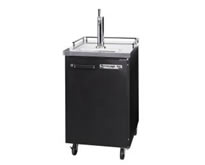
EdgeStar Kegerator

EDGESTAR HAS BEEN DISCONTINUED

EdgeStar Kegerator 
Under $400.00
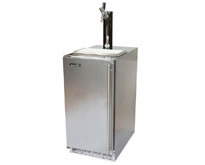
This kegerator from EdgeStar is the most affordable full-sized kegerator on the market today. The kegerator stores up to a full sized half shell Sankey standard keg and is perfect addition to your home for fall entertaining. See Kegerator Details


Haier BrewMaster KegeratorHaier BrewMaster Kegerator
$529.99
This is the Honda Civic of kegerators. Durable, dependable and you will get a lot of mileage out of this machine. The kegerator will hold a full sized keg or multiple homebrew style kegs when modified with a dual or triple tap tower. The auto defrost, temperature control and cooling plate are nice features too.  See Kegerator Details


Beverage Air KegeratorBeverage Air Kegerator
$1,399.00
With this heavy-duty kegerator you can keep your keg cold with precision. Perfect for the serious draft beer aficionado, this kegerator comes with a stainless steel worktop and high quality refrigeration components. This kegerator would probably last a lifetime, so if you need a workhorse this is your kegerator. See Kegerator Details


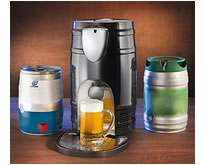
Mini Keg DispenserMini Keg Dispenser
$159.99
Ever seen the 5 liter mini-kegs at the supermarket? Well here is a 5-liter dispenser/cooler that will keep your favorite beer or soda ready-to-serve cold. Features include an easy flow design, drip tray cover, brushed aluminum door panel and indicator light. HelmanGroup.com


Kenmore KegeratorKenmore Kegerator
$594.99
This kegerator is a nice full sized unit with all the bells and whistles of the Haier BrewMaster kegerator. This unit stores a half-barrel keg, so your favorite beer is always on tap. You can also store quarter-barrel kegs and mini kegs. Store pickup at Sears is a nice option for those looking to save a few bucks on shipping costs.  See Kegerator Details


SudsBuddy KegeratorSudsbuddy Kegerator 
$1,399.98
A truly stylish kegerator that definitely is thinking outside of the box. Made of polyethylene plastic, this kegerator is dent-resistant and weighs less than 60 lbs making it easy for portability. It even has a cigarette-lighter adapter. How cool is that?. See Kegerator Details


Viking KegeratorViking Kegerator 
$2,899.00
If you are an appliance snoot that only lives for the finer things in life, then I would like to introduce you to the Viking kegerator. This is the Lamborghini of kegerators. Stick this beauty next to your outdoor Sub-Zero and Wolf range to wow your guest and serve delicious draft beer. See Kegerator Details


Perlick KegeratorPerlick Kegerator 
$2,889.00
This ultra-slim kegerator defines luxury. It is designed with fully integrated depth to allow flush fit with surrounding cabinetry. If you are thinking of installing a kegerator into your cabinetry or you are a contractor designing a  home bar, you can’t go wrong with this ultra modern kegerator design. See Kegerator Details


Fridgidaire KegeratorFridgidaire Kegerator 
$1149.00
This is for all you old school beer lovers that built a kegerator when you were in college out of an old refrigerator. Well, here is a beautiful replica made by Fridgidaire. It features a freezer on the top to store cold mugs and accommodates Up To a 16-Gallon Keg.  See Kegerator Details

Kegerator Video Contest

Enter to Win
Kegerator Video Contest

Well… It’s that time again. Time to give away a really expensive appliance in return for a few laughs. If you have not already heard, we are running a video contest asking the question, "What would you do for a kegerator?"

This is your chance to get crazy stupid-creative and impress the judges with your mad director skills. The lucky winner will receive a free kegerator and forever enrich their lives with kegerator companionship.

The skinny on the contest is as follows:

1. Make a funny, shocking, cool, stupid or impressive video showing us "What you would do for a free kegerator".

2. Submit your video to YouTube or Google Video.

3. Fill out the form here and you could win a free kegerator.*

Good Luck and go crazy!!

Deadline to submit a video: August 31th

Imported Beers Taste Better In a Can?

One of the great joys of the golden age of microbrews in which we live is the availability of beers from around the world. In most major cities in the U.S., you can find nearly any kind of beer. Many brands are imported from Germany, France, the U.K., Belgium, Japan, even Africa. If you can’t find it imported, the chances are that you can find an American made version of it. I will list some of my favorite imports here.

It is hard to stomach, but let me be the first to say: Newcastle in a can is better. I have always disdained canned beers ever since I started home brewing. Glass preserves the flavor, I used to say. Well it turns out that the clear glass bottles that Newcastle comes in don’t preserve the flavor as much as the opaque aluminum can. This is entirely understandable: sunlight is well known as a degrader of hop character in beer. This is why most ales of Newcastle’s quality are served in brown bottles. When Newcastle is drunk form the can, however, I must say that the taste improves. I can sense the light hop character I never before had in the beer, and it just seems fresher. Well, at least now I know: it isn’t always the container, but more what they put in it!

Of Guinness, it is always heard: much better in Ireland. There are many potential reasons for this, and I do believe it to be true, but if you live in the states, what can you do? It makes sense that Guinness at the brewery is made the same, whether in Ireland or the United States. It is my belief that from every moment after the keg of Guinness leaves the brewery here in the states, or is hauled off of the boat, it is at risk. This is partly because the beer is extremely sensitive to temperature changes. If it is not kept cool throughout transportation, it will undergo changes. If the tap system at the bar has hoses that are the wrong length, the carbonation will change. And the most obvious difference is that seemingly 99% of barkeeps in this country do not know how to properly pour a pint of Guinness! All the rest might as well be left up to chance, but it is high time that uninformed barkeeps in this country learned how to do it right. For those of you who have not been to Ireland, this is how you do it: First, pour roughly 2/3 of the pint full, at a slight angle of the cup. You then let this settle. It usually takes about 45 seconds for the initial pour to settle. Then you top it off and hand it to the patron. If you want to get fancy, you can make a leaf or such design in the foam on top, like they do with lattes. This method of pouring is the proper way, and allows the perfect degree of carbonation and proper head. If you are hazy on any of this, you should plan on going to Ireland to see how it’s really done. I recommend flying into Cork.

From Scotland, we have a true treat: in the ancient tradition of Heather Ale, Fraoch! This is a hop-less, or Gruit-style ale that is a little expensive, but well worth it! This craft ale is made in Scotland by Williams Brewing Company, and represents an elusive tradition of brewing that goes back 2,000+ years. The beer itself is a malty and rich amber with unusual bouquet. The beer is infused with both Heather and Sweet Gale, and imparts a lively inebriation to the imbiber. If you are a beer fan, you must drink this ale before you die! If you are a home brewer, try making some just to keep a 2,000 year old brewing tradition alive. The Fraoch website has some great reading materials on the history of heather ale viewable at: http://www.fraoch.com/history.htm

As delightful as it has been, I must now be off to dream further dreams of ales imported from the land of Morpheus. Until next time, drink it in good health!

Guide to Texas Beers

Texas Beers

Texas has a long history in beer – both drinking and brewing. In addition to the long-standing Spoetzl Brewery (the makers of Shiner beers), and the ubiquitous (if watered down) Lone Star, new micro-brews are taking the state by storm. With solid traditional and inventive ales, newcomers like Saint Arnold and Real Ale Brewing Company are challenging the old hands to do better than what they’ve done. This battle seems to be playing out to the benefit of Texas beer fans.

The great history of Texas beer starts with the building of the massive Lone Star Brewery in San Antonio in 1884. Adolphus Busch, of Anheuser-Busch, started the enterprise along with some local San Antoners and created the first large mechanized brewery in Texas. But Lone Star beer came much later (1940), and the brewery first pumped out bottles of Sabinas and Champions.

While San Antonio was busy brewing for the local populace, a group of brewers in Shiner, Texas had big plans. This group started one of the most enduring breweries in the nation, Spoetzl Brewery. The brewery first started operations in 1909, and changed hands in 1914 with the coming of immigrant Kosmos Spoetzl. Spoetzl had studied for three years the art of brewing in Bavaria, and served out his journeyman-ship in Cairo, Egypt, making beer for the Pyramid brewery there. Making his traditional family recipe, Spoetzl garnered a following, and then prohibition hit. The brewery somehow managed to survive by selling ice and “near beer”, and weathered the storm from 1919 until 1935. Although prohibition was hardly enforced in Texas during this time, due to fierce controversy, it affected large breweries greatly, and Spoetzl was able to avoid much trouble by dealing strictly with locals in a 70 mile radius and selling his near beer. The Shiner website points out that Spoetzl was very forgetful, though, and sometimes would forget to remove the alcohol from his beers. Tsk, tsk.

Starting in 1994, Houston’s Saint Arnold Brewery opened their doors, and is widely acknowledged as Texas’ oldest craft brewery. Named after the patron saint of brewing, St. Arnold is a brewery that has always had a mind towards the utmost quality. With a hard working staff of only seventeen people, St. Arnold still pumps out ten varieties of beer every year – five varieties continuously, and five seasonally. Even though they’ve been in business for over 13 years, St. Arnold’s maintains it’s dedication to serving their local beer drinking community.

Other micro-breweries started popping up throughout Texas around this time. As early as 1993 in Austin, Texas, the Waterloo Brewpub began selling it’s beers in half-gallon growlers, fighting against laws that inhibited microbrewery operations. Sadly, this brewpub is now closed due to rent increases, depriving Austin of it’s first micro-brew-pub.

In 1996, the Real Ale brewing company opened up in Blanco, Texas, not too far from Austin in the hill country. Although Real Ale is not, by international standards, “Real Ale”, by U.S. beer standards, who can hold it against them? According to the U.K.’s CAMpaign for Real Ale, Real Ale can only be used when describing beer that is "brewed from traditional ingredients, matured by secondary fermentation in the container from which it is dispensed, and served without the use of extraneous carbon dioxide". Although the Real Ale Brewing Company uses the finest ingredients, it certainly cannot be held to CAMRA’s standards.

Possibly as a response to these breweries and others, such as 512 BrewingLive Oak, Independence, and Rahr & Sons, all micro or craft breweries, Shiner has recently produced a small batch craft brew to celebrate 96 years of brewing. A little known style of beer called Martzen, the Shiner 96 is much stronger than most offering from the company, weighing in at 5.8%.  Traditionally Martzen, which is German for March, is a beer brewed in march and enjoyed during the autumn months. According to the Shiner website, this ale was drunk at the royal Bavarian wedding ceremony that started the Oktoberfest celebrations.

It is good to see larger breweries getting back to their roots, and embracing the folk lore that is rightly their heritage. This seems to be a growing trend in brewing: brewers highlighting the social context and history of the beer they brew. Beers that get too big seem to lose their character – both taste-wise and lore-wise. Shiner is doing a good job of maintaining both. They just needed a little prodding from the (little guys) competition.