Hefeweizen Hummus

Hefeweizen Hummus

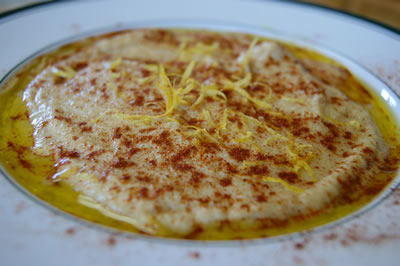
A simple, delicious hummus recipe using Hefeweizen. Perfect for the summer.

Ingredients

  • 1 can (19 oz) chickpeas, drained and rinsed
  • 1/8 tsp granulated garlic
  • 1/2 tsp roasted ground cumin
  • Freshly squeezed juice from one lemon
  • 1 tsp fresh lemon zest
  • 1 tbsp extra virgin olive oil
  • 3-6 tbsp Hefeweizen beer
  • Bolivian rose salt, to taste
  • more olive oil, for drizzling
  • dash of smoked paprika

Place chickpeas, garlic, cumin, lemon juice, ½ t lemon zest, olive oil and 3 tbsp of beer into a food processor and process until pureed. If necessary, add more beer a tablespoon at a time until hummus reaches a smooth consistency. Now mix in salt to taste. Serve hummus in a bowl; drizzle with olive oil and sprinkle with paprika and remaining lemon zest.

Hefeweizen Hummus

Serve with toasted bread, sliced carrots/celery and Unfiltered Widmer Brothers Hefeweizen

Let a Kegerator Help You Deal With Tax Day

Let Your Kegerator Help You Deal With Tax Day

Tax day is one of those days that make many people cringe. The thought of April 15th, and the knowledge that your taxes must be completed and mailed to the IRS by that date (not to mention the hefty sums that you may have to send in with your tax return), has caused that mid-April day to be one that is met with a bit of disdain. That is, unless you are an accountant, and then you know that April 15th is the day you get your freedom back and stop working 15 hour days to get everyone else’s tax returns completed in time.

Either way, a kegerator is one of those unexpected accessories that may be a welcome addition to your April 15th routine. Whether you are dreading the day because you know that you need to send your taxes in and you owe a lot of money, or you are on the other end of the spectrum and eagerly anticipate the day for months because you know it is when life returns to normalcy, there is definitely a place for an afternoon or evening spent worshipping your kegerator.

Think of it this way – if you’re in a crappy mood because the government is taking all of your hard earned money in taxes, what better way to stop worrying about things you can’t control than to grab a frosty mug, mosey up to your kegerator, flip the kegerator tap so that a bit of liquid gold comes pouring out to fill that mug, and then take a seat to enjoy the rich, fresh taste of your draft beer while you let your worries roll off your back.

If one trip to the kegerator isn’t enough to cure your tax day blues, then the answer is relatively simple – just take another trip or two back to that kegerator until you start to feel better. Just make sure you don’t make too many trips to your favorite draft beer dispenser, unless tax day falls on a weekend this year, because tomorrow you have to head back to work to start earning a bit more to give to Uncle Sam next year, and also of course, to refill your kegerator.

If, on the other hand, you are one of the many accountants that makes their bread and butter during the months preceding tax day, but works their fingers to the bone during that time, then April 15th is a day worth celebrating. No longer will you need to work long, grueling days, dealing with other people’s financial woes. It’s back to business as usual for the rest of the year, or at least until New Year’s Day rolls around. But before that relaxing schedule starts to set in, it’s worth also celebrating the fact that tax day for you as an accountant is like Christmas in April, since it is the time of the year that brings you the most financial reward.

That celebratory day is another reason to enjoy the contents of your kegerator. If you have a mini kegerator, you may even want to consider bringing it into work so as soon as the last tax return is mailed, your co-workers and you can start the celebration with no wasted time. Of course, if you plan on bringing your mini kegerator to work, be sure to check with your boss first, or it may be the last tax day you are employed at your current place of business.

So, if you are looking for a great way to deal with tax day, whether to beat the tax day blues or to celebrate the end of a long, difficult work schedule, a large paycheck and the beginning of a more normal life for the rest of the year, then grab a mug and head to your nearest kegerator.

After A Day of Service on MLK Day, It's Kegerator Time!

Martin Luther King Day

Martin Luther King Day, also known as MLK Day, is a federal holiday in the United States dedicated to the remembrance of the Reverend Dr. Martin Luther King, Jr. It is observed on the third Monday of January, which coincides with the date of Dr. King’s birthday, which is on January 15th. The holiday has come to be observed as a day of service, spurring Americans to spend the day giving back to the community in some way by volunteering their time and effort to make this world a better place.

If you are one of the thousands of Americans that truly honor the spirit of Dr. Martin Luther King by getting out within the community to volunteer your services, then you should pat yourself on the back. And when you return home at the end of the day, if you have a home kegerator, you should pour yourself a fresh, draft beer and take a moment to reflect on Dr. King’s vision, as well as the part you have played on this day in bringing that vision closer to reality. Sure, there’s no correlation between the holiday of Martin Luther King Day and kegerators or beer, but the point is this – if you are one of the upstanding citizens of this country that believes in the importance of getting out there and giving back to your community, then you deserve that kegerator, and you certainly deserve that beer at the end of the day.

Better yet, consider bringing out a whole group of people to volunteer with you on this national day of service. Volunteering together as a group is fun, and it brings people closer together. It also motivates people to do more than they would do alone. Then, when your volunteer activity is completed, invite everyone back to your house to gather round your trusty kegerator and share a few drinks, and a few stories of the day. Sure, this isn’t quite the same type of festive holiday as Thanksgiving or Christmas, where you expect to gather with family and friends and give thanks for the blessings of the day. Nevertheless, in the same tradition as holidays such as Veterans Day, Martin Luther King Day is a day to give thanks for the ways that this world has changed in the time since Dr. King’s famous speech. If that happens to get done while gathering around an in home kegerator, so be it. Celebration is celebration.

Of course, you don’t need a kegerator to celebrate the vision of Dr. Martin Luther King. But it is nice to have one (or even a mini kegerator) to come home to at the end of a hard day’s work. On this day, many schools and businesses are closed. This means it is also a good opportunity for family and friends to come together. And anytime that you get an opportunity to get together like that, rather than having to head to the office, it is worth inviting a few friends over to share a few beers straight from your kegerator. It’s better and cheaper than heading to the local bar or tavern, and it gives you a chance to unwind and socialize right in the comfort of your own home.

Remember however, that MLK Day always falls on a Monday. That means that there is still a long week of work ahead for most people. So, while you may want to tap the kegerator so you can have a beer or two, leave it at that, or you’ll be feeling the effects as you head off to work the next morning, knowing that it’s only Tuesday and you have to make it through a long week.

It's Christmas Eve. Time to Tap the Kegerator!

Christmas Eve Kegerator

Christmas Eve. In popular songs, it’s a night filled with wonder and hope, excitement and anticipation. At least if you’re a kid. As a small child, you put on your new pair of jammies and hustle off to bed, awaiting the arrival of the jolly ol’ man himself and all the gifts that he brings. For some, sleep comes quickly, because they know that Santa can’t arrive until they are fast asleep. For others, the excitement of what is to come makes them toss and turn all night long.

But what if you’re an adult on Christmas Eve? Chances are that you have loads to do to make the upcoming Christmas Day one that is extra special. There may be gifts to wrap, trees to decorate, lights to hang, and food to prepare for family and friends. Feeling a bit overwhelmed? That’s why it’s a good idea to tap into your home kegerator to set the mood and make the long to-do list a bit more palatable.

If you have a kegerator, or even a mini kegerator, you probably already know how good it can taste to fill up a nice cold, frosty mug of beer. On a night such as Christmas Eve, which can sometimes turn into a stressful time filled with lots to do, a kegerator can be a lifesaver – giving you a chance to relax and unwind a bit as you cross things off your list one by one.

Sure, you can also open a can or bottle of beer that’s sitting in the fridge, but the taste of a draft beer straight from the kegerator tap is smooth and appealing on a busy winter night. And chances are, there’s no room in your fridge anyway because it’s filled with all the fixings for tomorrow’s big holiday meal. So, unless you have an extra fridge in the garage or basement, or you have a kegerator, you may not have access to that great tasting beer at all.

Why drink beer on Christmas Eve, rather than wine or even egg nog?
We’re not saying you can’t, but if you like beer, you like beer. Wine can make you sleepy, and you can’t afford to be sleepy on a night like this – there’s too much to do. Egg nog is a great drink to have once you’re all gathered together in celebration of the holiday, but it is rather heavy and sweet and is not the type of drink you typically have on its own, without the accompanying holiday festivities.

So, once you get the kids to bed, why not thinking of heading over to your kegerator with your spouse and taking a few minutes to share a refreshing beer together as you plan your night’s activities. Then you can divide up the chores, put on some festive music, and get to wrapping, and decorating, and preparing food for the day ahead. Make it a point to reconvene by the kegerator, or by the fireplace if you’re looking for something cozy, at the end of the evening, to maybe share one last drink and rejoice in the excitement that the holiday brings, despite all the work that may be involved now that you’re an adult and not a wide-eyed child. Then call it a night, and head off to bed, dreaming of the joy-filled day that lies ahead.

10 Weird Things to Convert into a Kegerator

Kegerators come in all shapes and sizes, and many beer fans are showing a great degree of creativity in their manufacture and decoration. Here are the top ten weirdest chassis that I have seen for home beer dispensing recently:

The GameratorArcade Game
Available from thegamerator.com for a mere $3,499, the Gamerator comes loaded with approximately 100 classic arcade titles such as Space Invaders, Operation Wolf, Mrs. Pac-Man, Mortal Kombat, and many more. Too bad they don’t include a keg of beer for that price tag.


Lake KegeratorLake
A primitive, yet functional solution for a “redneck” kegerator is simply throwing the keg in the lake to keep the beer cooler than “hot summer day”.  Also handy for determining the level of beer in the keg – the higher it starts to float, the closer to empty it is.


Steampunk "Brewery" Computer Computer  
I highly doubt this unit dispenses beer, but it is being heralded as such.  Perhaps there is an attachment for a beer in line somewhere around back… from Russia or Poland, I hear.


BikeratorBike
This mobile draught beer system looks like a fun ride.  Two taps of high quality beer staged in a very mobile beer cooler.  Looks like it might hold full regulation-sized kegs, too.


Butt Crack KegeratorButt Crack
This kegerator is a little more creative and a lot scarier – Butt crack kegerator.  Not sure how much beer this ass can hold, but it sure is hilarious.


VW TrunkVW 
This kegerator brings new meaning to a “tailgate party”.  Sure to be a hit in the stadium parking lot.  I hope the owner made the tower modular, or else he might find his trunk has been jimmied while he was in the stadium watching the game.


Trash Can KegeratorTrash Can 
This kegerator idea is a perfect mod for trash cans of all types.  The bigger, the better, and more taps available.  Foam board insulation can be easily cut and installed for this style of mobile beer cooler.


Wine or Whisky barrelWine or Whisky barrel
Your local wine or whisky maker usually sells used barrels and half barrels to the public.  One of these can then be converted into an antique looking kegerator… and they’re great for renaissance fairs!


Vintage Gas Pump Vintage Gas Pump
For gear heads or race fans, an antique fuel pump makes an awesome kegerator conversion.  I’ve actually never seen one of these in person, but have heard stories that it has been done before. Just make sure that you get rid of that gasoline smell.


Antique RefrigeratorAntique Refrigerator
Although this may not seem that strange, it is one of the harder kegerator projects.  Older units, with the streamlined look usually don’t work – this requires rebuilding or replacing the whole refrigeration machine – running new coolant lines, fixing rusted out spots of the chassis, most likely getting a new compressor, rebuilding the weather-stripping, and a whole laundry list of other potential problems.  The result is fabulous, though.

Columbus Day Revisited: Imagine if Columbus Sailed The Ocean Blue With a Kegerator Onboard

Columbus Day Revisited

Imagine this. The time is 1492. The place is onboard the Nina, the Pinta, and the Santa Maria, sailing across a vast ocean. The person, of course, is Christopher Columbus, one of the most famous explorers of all time, as well as his crew. The journey, a trip from Spain that ultimately resulted in the “official” discovery of the Americas. Imagine the difficult journey it must’ve been – one wrought with disease, doubt, and disbelief.

Now close your eyes and imagine this same journey with a couple of kegerators on board the ships. Rather than there being long grueling days filled with hardship and doubt about where the journey would ultimately land these brave men, there might’ve been relaxation and rejoicing at the end of a hard day’s work. And rather than there being disease and illness, such as scurvy caused by a lack of vitamin C since there were limited fresh fruits and vegetables available, the explorer and his sailors could have been enjoying the benefits of something like Bud Light Lime, spewing from draft beer dispensers and filling their guts. Maybe even supplying enough of the needed vitamin to keep them from developing such a debilitating condition.

Okay, you might say. That’s a bit ridiculous to think of kegerators on board Columbus’s ships. Or Bud Light Lime. But we’re not reinventing history here, we’re just imagining how things might have been different. What if each and every ship had its own kegerator, or even two, onboard? It doesn’t matter what type it was – it could’ve been a single tap kegerator, a double tap kegerator, or even a mini kegerator. The point is that there was a way for the crew to enjoy fresh, cold beer while out on the lonely, dark sea each and every night during a journey that took them far from home.

So, the stage is set. We’ve got three ships filled with weary men that don’t know where they are headed and that are tired, lonely, anxious and bored. Now we turn on the taps of our modern day kegerators transported back to the 1400’s and the whole demeanor of the journey changes. No longer are our men miserable and weary at the end of the day. Instead, they can sit down and relax with a cold, refreshing brew or two. They can have a few laughs, make a few friends, and instead of worrying about where they are headed, they can rejoice in the incredible journey that they have embarked upon. Maybe there will even be a bit of mischief and rowdiness on board the ship. That’s possible, but who cares? It’s not like their ship is going to sail into another one out there. Or that they’re going to miss their intended destination (wait, didn’t that happen even without the kegerators and the beer?).

During Columbus’s actual journey, his crew became apprehensive about the longer than expected route and the fact that a land filled with spices, gold and jewels was nowhere to be found. Despite Columbus trying to ease their fears by forging the ship’s travel logs, things got to a point of near mutiny. Luckily for ol’ Chris, he spotted land just a day before he promised that he would turn the ships around and head home. So, do you think that his crew would’ve gotten to the point of near mutiny if they were enjoying their kegerator-equipped ships filled with delicious, refreshing beer each day? We think not!

….So, this year, when the second Monday in October rolls around and we remember the man and the journey that made Columbus Day a holiday, be sure to grab a glass, pour a cold, frosty one from your in home kegerator, and think about what might have been if kegerators were onboard the Nina, the Pinta and the Santa Maria back in 1492.

Extreme Kegerators

There’s a new trend taking place amongst kegerator builders that is taking some of their designs to the extreme. Bigger, faster, stronger is the American way and so why not apply that to the modern kegerator? Well here is a few of the extreme kegerators we have been seeing lately that are likely to spawn a whole new way of thinking when it comes to drinking draft beer from a kegerator.

Kegerator Cabinet

Garage Tool Cabinet Kegerators
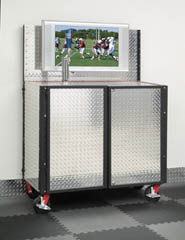
If you were out shopping for a new tool cabinet for your garage you would expect to find features like durable chrome plating or rolling casters, but would a kegerator be an upgrade you would be interested in? Garage Fabricators from Central California thinks it should be. They’ve created the Diamond Plate Kegerator Cabinet that comes fully loaded including powdercoated steel plating and welded 6" phenolic casters. The kegerator cabinet is 23.5” deep x 47.5” wide x 64” tall and has the option of a Flatscreen TV mount. For only $1,678.57 you can call one of these kegerator cabinets your own.

Arcade Kegerator

Arcade Machine Kegerators
Whether its Pac-Man or Mario Brothers, imagine having access to fresh draft beer while playing your favorite arcade games. Well, two companies we’ve found seem to have the same idea. The Custom Bar Guys in Roanoke, VA have created THE GAMERATOR. The Gamerator offers access to over 1,000 classic and current arcade games and a refrigerated interior capable of holding a pony keg of draft beer. A device this unique is surely worth the $3,995.00 price tag, so order yours today, as they are handmade upon order and take up to 4 weeks to build.

Racing Arcade Kegerator

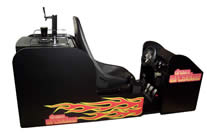
Another company integrating a beer experience for gamers is Dream Arcades out of Folsom, CA. They have created a racing arcade kegerator entitled the Octane 120 Beer Arcade. The Octane 120 is a home arcade gaming system that combines three things every adult gamer wants: classic arcade games, arcade-style racing, and a full sized kegerator with in-dash beer tap to get your favorite beverage without having to get out of the seat. Only $6995 (S+H) and it’s all yours!

Hitch Mount Kegerator

Hitch Mount Kegerator
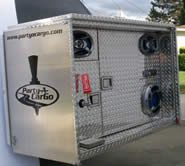
California companies seem to be all over the extreme kegerator setups and Party-A-CarGo out of Concord, CA is no exception. They have put together a hitch mounted kegerator / entertainment system. Tailgaters, campers, or weekend warriors can pour up to 160 ice cold beers, play 12 hours of music and watch the early games on TV without having to recharge their battery, refill their cooler with ice or clean up empty beer cans. Check out Party-A-CarGo to get all the details on this extreme kegerator.

Breweriana: Specialty Beer Glasses

Specialty Beer Glasses

Specialty glasses have existed throughout the ages, whether they are for wine, champagne, or different types of beers. From crystal goblets to stoneware steins, and, more recently, Belgian glass goblets, glass, ceramic, wood, and metal crafters have produced their visions of the perfect vessel for the perfect drink. The ratio of slope to surface area, breathing area, and volume contained within, are all tailored to the liquid viscosity and temperament of the beverage in question.

Having a unique specialty beer glass for each of your alcoholic beverages has always helped to make the moment special. Who ever heard of sitting around the local pub, drinking mugs of ale? That may be true for mid-evil re-creationists, but most beer fans prefer pint glasses. That way you can see what you’re drinking. In mid-evil times, you didn’t always WANT to see what you were drinking.

Having a nice rack of differing specialty beer glasses is good for when company comes over. It can encourage your friends to bring some fine ale if you have some Chimay glasses around. These glasses are called chalices, and feature a wide, flat bottom and straight sides to allow the many aromas of the monk-style Belgian ales to be smelled.

Having a set of German bier Steins up on the shelf may also lend clues to guests as to what you’d like at the next potluck (better Heineken than Budweiser, at least). The stein and the mug are best suited for ales of the inimitably quaffable kind. Beer that is guzzled easily. Beer that you want to drink a lot of because you want to become intoxicated.

European specialty beers often fall into the category of beers that should be served in specialty beer glasses. If you walk into a bar that serves a selection of Belgian ales, this is a good place to learn more about the difference between specialty beer glasses, but until then take my word for it: Weiss biers and hefeweisens have a glass which is curvy and top heavy. This gives a little lip at the bottom to catch any yeast sediment, which may result from drinking the bottle-conditioned variety of theses ales.

Pilsner glasses are the more straightforward, simple and elegant tall glasses with only the slightest of curves. The relatively narrow top channels the bitter aromas into the nose, facilitating an aromatic blast with each swig.

Lambics, being specialty ales from a nation of specialty ales, are best indulged in what is known as a flute glass. This resembles a champagne glass, but with more curves. This keeps the bubbles moving around, for like champagne, lambics are highly carbonated. The narrow top keeps the aromas from floating about too much.

Barley wine glasses usually hold less beer – barley wines being much stronger in alcohol and flavor than regular beers (around 7%-12% alcohol). In order to prevent patrons from stumbling over each other drunk or passing out in the bar, the volume of the glass is decreased. The glasses usually have a fairly open top to allow the rich and malty bouquet of the barley wine to waft above the specialty glass. Go to a good barley wine tasting and you will see what it is all about.

The Samuel Adams brewery of Boston, Mass., just this last year released a glass, which their brewers claim, serves beer as brewers intended. The Samuel Adams Boston Lager Pint Glass shares many traits with the flute, but it is bigger and has a much wider mouth.

"We wanted to create a glass that offers beer lovers a full sensory experience by fully showcasing Samuel Adams Boston Lager’s complex balance of malt and hop flavors.", said Jim Koch, founder of Samuel Adams.

And last, but not least, one good reason for having different specialty beer glasses, for different kinds of beers, is to help bar patrons to remember which glass is theirs. A night of drinking can sometimes muddle ones perceptions. In any case, is not a finely crafted beer worthy of its own glass?

Breweriana: Collectible Beer Steins

Beer Stein

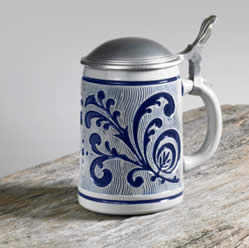
Breweriana is the collective detritus of breweries and beer fans from the days past.  Breweriana takes many forms, but the arguably oldest form of collectable breweriana hails from Germany, where beer Steins or bier Steins have been crafted sold and handed down for generations.  Although the tradition of beer steins has largely faded from practical use, those who have been left with old hand me down beers steins may find that they have antique treasure worth up to $3,000.

Originally known in German as the "Steinkrug", the beer stein is a traditional mug for serving beer, which can be made of porcelain, silver, crystal, glass, or wood.  Some steins have an open top, but most collectable varieties have an intricately cast or carved lid with a thumb-action lever.

As a child, I remember looking up on the shelf in the den and seeing the variety of intricately crafted beer steins.  Amid hand me downs from the family past were also spoils of war from my grandfather’s campaign in Europe during World War Two.  Such history was held in those beer steins, and swept away with the intervening years so that today, I have but two of the remnants of that fine collection.

Although not seen in the pub or at parties much these day, the practical benefits of the beer stein are as useful today as they were in the 17th and 18th centuries.  Although replaced with the pint glass in most pubs, the stein typically holds at least as much beer as a pint glass.  Older steins are likely to hold around one and a half liters of beer, which, back in those days, was considered one serving of beer.  More modern sizes from Germany are likely to hold only one liter.

It was in the 14th century that beer steins first started becoming fitted with hinged lids.  The lids were indeed sanitary measures, the result of a German law that all food would need to be covered in order to prevent the spread of disease.  This law came with many other laws that popped up at this time, when Europe came back from the brink of decimation as a result of the black plague.  For instance, pigpens could no longer run up to the edge of streets, meat that was old or came from a diseased house had to be labeled accordingly, and the German Beer Purity Laws began.  It is from this stage that beer began to be homogenized on a national level:  beer could only be brewed from hops, barley, yeast, and water.

Steins remaining from the periods earlier than the 14th century tend to be made of pewter and silver, as the earthenware and wooden steins from that period were easily broken over the yawning of the years.  The pewter guilds held onto the premier production spot for steins until the ceramics crafters of Europe invented stoneware, which proved much more durable that the old clay earthenware.  Not long after, porcelain and glazes also emerged on the scene.  A lot of advances in stein technology occurred around the 1700s, of course, during the Renaissance.

The additional benefit of the thumb-action levered steins come in especially handy for keeping unwanted materials out of your beer.  Flies, stray cigarette ash, and bits of food are always a downer when you find them in your beer.  I still use my capped stein from time to times when I find myself going to a party where such detritus may find its way into my beer.

Some varieties of stein have their own terms from the German, which you may run into while searching for the beer stein that fits you: 

  • "Humpen" are steins that are made from stoneware, using the process which partially smelts the clay together, producing a harder and less porous product.
  • "Steinkrug" are earthenware steins.
  • "Glaskrug" are glass steins, very few of which survived from ancient times.  Some of these are actually crystal.
  • Another term you might come upon is "Maßkrug", pronounced ‘moss kroogh’ in English.  These are steins that are explicitly measured out for one liter.

Hunting for steins is a fun and rewarding exercise in antique shopping.  Steins can be found in nearly every antique shop, and who knows, with a little knowledge you may find a valuable treasure in your breweriana adventure.

Evolution of the Beer Keg

From wooden casks to stainless steel and aluminum, from spile and shive to Sanke tap, the evolution of the beer keg has also influenced the evolution of beer. Driven by the mass production demanded by beer fans the world over, brewers have tinkered with and improved the beer keg in many ways during its evolution. Some of these changes have also impacted the quality of beer and even the brewing process. Though the old style cask ales, or “real ales” are still in production in some parts of England and the U.S., modern beer is dominated, even in the microbrew and craft beer markets, by pasteurized and filtered beers. Here we will look at the evolution of the beer keg and the effect mass production has had on the beer it has kegged.

Evolution of the Beer Keg

History shows us that the drinking of beer goes back at least 4,000 years. In that time, beer was most likely stored in clay urns and pots. But somewhere along the line, humans discovered that beer could be carbonated by sealing it in a bottle or cask and letting the yeasty “spirits” or “miracles” of fermentation go about their business. With this discovery came the first beer keg.

As far as historical records go, we can see a lot of light shed on the development of beer in Europe. Originally, European beer, i.e., beer-as-we-know-it-now, was predominantly kegged in wooden casks. These casks were usually made of oak or other hardwoods that had a reputation for being non-toxic. Beer at this time was un-pasteurized and usually unfiltered, which lent it to spoiling. This beer had an expiration date!

Most of the advances in brewing and kegging technology since then have focused on increasing the life span of beer. The most important of these was the process of pasteurization. Pasteurization is a process by which a product in a bottle or can is rapidly heated and then cooled. This process ensures that any organism that may be purposely or un-purposely left in the product (in this case, the beer keg) is killed. Through the use of pasteurization, beer kegs have been granted a much longer shelf life.

For some, the change in taste that the pasteurization process yields is too much to ask for the benefits of increased shelf life. An organization known as CAMRA, the CAMpaign for Real Ale, has taken up the cause of un-pasteurized and un-filtered beer. Through this group, folks interested in cask ales and real ales may find them in the U.K. Interest in cask ales is present in the U.S. as well, although the term real ale does not have the same weight as in the U.K., where strict guidelines have been established. Real ales are those ales that are still “alive” with living yeast. Cask ales are ales that are served from a cask, although not necessarily a traditional wooden one. These ales may be filtered, but they are usually cask-conditioned. This means that they gain their fizzy carbonation through the natural process of fermentation instead o the “force-carbonating” that is usually done by commercial beer makers.

The modern Sanke beer keg is designed to be rugged, easily cleaned (at least with the right industrial keg cleaning machines, and to hold a great amount of beer while still being light enough to be handled by one person. Unlike the cask, the progenitor of the keg, the Sanke keg requires little preparation and knowledge to operate. Sanke kegs took the Shive hole and the keystone of casks and put them into the same hole, locked in with a coil spring and valve, released with the push of the tap once attached.

Today, most cask ales are served from steel or aluminum casks, just as regular beer kegs are. They still require the care of an attentive landlord or barkeep, however. The gas must be vented and the beer prepared two to three days ahead of time. The benefit of a little extra tooling and care produces the result of an ale the likes of which might have been enjoyed 2,000 years ago! For all the modern influence of technology on brewing, it is refreshing to see that some people still like to do things the old fashioned way.

See related keg beer articles: History of the Kegerator, Beer Keg Directory, Beer Kegging Tutorial