The Brew Scholar

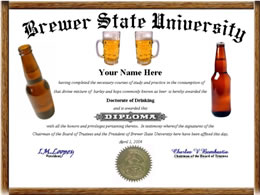
Brew Scholar Diploma

Brewing today is more of a science than ever. With advances in the specialty fields of micro-biotics and plant biology, this science is now receiving praise – and the degree programs – from the highest level of academia. The golden age of microbrews we are living in is giving more and more respect around the board to brewmasters, and has created a whole new field of academia – the brew scholar.

With more and more inventive and daring microbrews being created every year, we are seeing the ancient art of brewing given more and more attention. With a better understanding of what happens on the cellular level during each process of brewing – malting, mashing, fermenting, and kegging – efficient short-cuts and better ways of cleaning and sanitizing are becoming apparent. The advent of science of genetic engineering may provide even more efficient ways of fermenting beer as well. Already on the market is the product known as turbo yeast, which ferments quickly and more efficiently than most regular yeast strains. Alcohol fermented by the use of turbo yeast is used primarily as a fuel source or for distillates.

The use of Ethanol as a fuel source is growing rapidly. In Brazil, ethanol production is high, and new “flex” cars are being manufactured, which can run on either Ethanol, Gasoline, or a mixture of the two. U.S. president George W. Bush even visited there in March 7th of 2007, where he signed agreements with Brazilian president about importing alternative alcohol based technology from Brazil to the United States. The rise in value of Ethanol as an easy fuel to turn to has only increased opportunities for the Brew Scholar. After all, alcohol is most easily manufactured through the art and science of fermentation.

Speaking of which, there is a book by brew scholar and professor of brewing technology at U.C. Davis Charles W. Bamforth called Beer: Tap Into the Art and Science of Brewing. This book goes into scientific detail about all aspects of the brewing process, with a mind to a layperson’s understanding of the topics. This is an excellent book for those interested in the details of the process of making beer. This is a good place for a starting home brewer or beer fan to learn more about what they are drinking. Professor Bamforth also gives lectures from time to time, so keep an eye out for his name in your neck of the woods.

One interesting development in the birth of the brew scholar is that many respectable Universities are now offering degrees in brew science. The U.K.’s University at Nottingham has offered since 2006 a master’s course which is open to graduates as well as current brewery employees. Class topics include yeast efficiency, brewery design, and more.

At U.C. Davis, in northern-central California, malting and brewing are taught as part of the bachelor of science degree in Food Science or the master’s degree of science within the Food Science Graduate Group. This is where Professor Bamforth teaches. There are three tiers to the Davis brewing program. First is Introduction to Beer and Brewing, which gets the student familiar with the importance of beer as an international industry, and a basic understanding of how industrial breweries operate. Next is the theoretical class Malting & Brewing Science, which familiarizes the student with all aspects of industrial beer production from growing grains to the point of sale. Thirdly is Practical Malting & Brewing, where the student learns “hands-on” in the brewery and at the lab about analyzing beer and the links of that analysis with production methods.

With the golden age of microbrews going strong, it will be a wonder to see what these new brew scholars can do with beer. We are sure to see more interesting varieties and more efficient beer production thanks to these new degrees. Blue-collar workers finally have something to thank academia for!

A Guide to Strange and Unique Beer

One of the greatest benefits of home brewing, and of the golden age of micro brew that we are currently living in, is the ability to create new and unusual brews.  The freedom that comes with experimentation in this realm knows no bounds except those of one’s own imagination and ability.  With practice and planning, even these limits will increase, as the breadth of knowledge in these fields is naturally increasing.  As the golden age of the micro brew expands to even more unique and inventive realms, we are even seeing the list of strange and unique beer that is commercially available expand.

Micro brewers have been experimenting with unique herbal beers well into the origins of beer.  Numerous recipes are available for your edification in books such as Sacred and Healing Herbal Beers by Stephen Harrod Buhner, and Wild Fermentation by Sandy Katz.  Sacred and Healing Herbal beers is by far the most influential book on brewing that I have had the pleasure to read.  My whole career as a hobby home brewer has, in fact, been based on this book, as has that of many home brewers that I know.  It is considered in some circles to be the “bible” of strange and unique beer.

To the beer drinkers of the United States, though, even something as simple as a Belgian White Ale is often considered exotic.  While the yeasts of such ales certainly lend themselves to distinction, I wouldn’t call them unique beers.  To qualify for this category, we must take into consideration the following:

Does the beer have a unique buzz or side effect?

And;

Does the taste of the beer differ due to an admixture?

Yeast has an important effect on the taste of any beer, but this only one aspect of beer production.  The quality of the water, the types and mixtures of malts and hops, and especially herbal admixtures affect both of these factors greatly.  Inventive processes can also enhance the taste of the beer. 

Water is the highest presiding factor over the quality of a beer; it makes up roughly 90% of the beer.  I have found that the best beer I have ever been able to brew used as its base pure Alaskan glacier melt water.  The list of all-organic ingredients helped, I’m sure, although other organic ales I have drunk have almost lived up to the taste of that ale, most notably the Fishtale Organic Ale.  I would call these beers of the highest quality, and the Winter Wolf Stout that I made with the Alaskan Glacier melt water “unique” due to the process of collecting the water.

There is one commercially produced ale that I have discovered to venture into the realm of herbal admixtures, although I am sure more are to come.  I am speaking of New Belgium’s Springboard Ale.  It is an innocuous sounding name, but this ale is truly a unique herbal concoction brewed up in the guise of a Seasonal beer: a Belgian Ale with the bite of wormwood and the tonic properties of Goji berries.

The Springboard ale boldly forges ahead to reclaim space for herbal beer brewers.  Ever since the German beer purity laws, or Reinheitsgebot, adopted in 1516, and even before, the powers-that-be have sought to implement control over what manner of inebriation is allowed to the general public.  The only ingredients allowed by law in ale were water, malt, and yeast… hops were added to the list later, by popular demand.  The only other brew known to contain an active amount of wormwood ingredient is the infamous Absinthe, outlawed in the U.S. and many other countries, but still sought after and made by high class moonshiners in the United States, and, I am sure, in other countries in which its production has been outlawed.

Before the release of Springboard, the United States saw a proliferation of specialty ales – some of which contained herbs, others of which contained specialty yeasts.  A variety of Belgian Ales as well as Fraoch Heather Ale paved the way for the release of New Belgium’s Springboard by exposing the beer fans of the U.S. to more and more strange and unique beers.

In my personal experience, home brewers have been the first to experiment with wild and imaginative combinations in strange and unique beer.  I have drunk of the “Orge-Clops-Itar Ale”, containing the herb eyebright, which is regarded as a beneficial tonic for eyesight.  The brewer stated to me that the inclusion of eyebright was to help with night vision and goblin sightings.  Another unique home brew was the “Skull Crushing Hammer”, a beer made with the herb Yarrow.  The herb is said to have immense healing qualities when applied in a salve to open wounds, but when ingested, has inebriatory qualities that enhance the effect of alcohol.

Amongst home brewers is probably the best way to expose one’s self to an amazing variety of strange and unique beers.  It may not be the easiest to find home brewers bent on such strange brews, but it will certainly be a rewarding endeavor.  It might be worthwhile to enquire at your local home brew supply store about some of the “crazier” brewers that come into the shop.

When home brewing was outlawed with prohibition, it took another 50 years before the state repealed the ban on home brew, and now, finally, craft brewing is overtaking the ground it had lost over 200 years ago.  Thanks to the home brew revival, authors like Stephen Harrod Buhner and Sandy Katz, and bold brewers like New Belgium, we are sure to see a revival on the field of strange and unique beers.

Brewing Up a Fine Camping Trip

When planning a camping trip, most people remember to bring the tent, the sun block, and the sleeping bags.  But many folks forget that special addition that can make the trip all the more enjoyable after a long hike: the home brew!  Most camping trips can benefit from some home brewed refreshment, whether a small hike or a full-blown lake fishing trip!  With the advances in home brew serving technology these days, it can be simple for friends, families, or couples to brew up a fine camping trip!

If you are going to the lake, or on another kind of car or R.V. camping trip, bringing a larger home brew setup is a great way to enhance the trip.  If you have room in your vehicle and a generator, you can bring along your home kegerator, but most people opt for the draft beer cooler for such trips.  A draft beer cooler is basically a plastic cooler that has either a copper or stainless steel cooling coil placed inside (with lots of ice).  The beer from the kegs flows through this cooling system and out of draft spigots mounted on the front of the beer cooler, producing a cool and refreshing draft beer with a very lightweight and easy to set-up apparatus.

Either draft beer coolers or beer cooler conversion kits can be ordered online, making it even easier for you to focus on your brewing for the camping trip.  Considering the cost of keeping a generator on and kegerator plugged our whole camping trip, the draft beer cooler is a much more economical option for your camping trip.  Make sure you have extra supplies of ice for your draft beer cooler.  If the keg beer flowing through your beer lines is warm, it will melt the ice inside quickly, and it will need to be replaced.  It is a good idea to keep the kegs insulated in thick blankets to keep it cool.

For smaller camping trips, such as one to three day hikes, or walk-in camping, a smaller beer cooler with a few bottle conditioned brews can be perfect.  For colder weather hiking, a nutritious stout, porter, or malty scotch ale is recommended.  These ales will keep you warm under the crisp, cold glare of starlight in the mountains, and help you rest.  No cooler is really necessary for these trips, as an icy mountain stream will cool your bottles off rather easily.  For warmer weather trips, coolers are advised, although it may not be necessary if cold-water streams are along your path.  But for warmer weather hikes, a lighter ale is recommended, at darkest an amber.

One fun aspect of the biggest camping days of the year, namely, Labor Day, Memorial Day, and Fourth of July, is making the extra preparations necessary to build a bar for your camp out!  If you already have a home bar, you will be able to take some of your sturdier decorations out to the campground.  The main issue will be having plenty of seating available for your patrons, be they friends, family, or fellow campers.  Turning your campsite into a party zone can make you some exceptional friends!  To avoid any unpleasant interactions with authorities, it is advisable to disguise your mobile draft beer system.  You may want to read my articles Entrepreneurship and Home Brewing and Disguising a Mobile Beer Draft System if you are planning on setting up a campsite bar during such major party weekends.

Whether you are brewing up a fine camping trip for a small group, or for a large assembly, the mixture of draft keg beer and the wilderness is a pleasant surprise for all.  The association of home brew and the great outdoors is an apt one; brewing one’s own beer is healthier than accepting the bland corporate beers offered in most of the nation, and is especially refreshing after a constitutional in the great outdoors!

Kegerator Giveaway Contest Update

I wanted to let everyone know how great the kegerator contest is going. I have received over 1000 entries in less than 13 days. I’ve received emails from troops in Iraq, teachers in Ohio and homebrewers from all over the U.S. This is really exciting to think that someone will actually win this keggerator and someday be pouring a cold one from it.

I also wanted to clarify that I have the option to pay or not to pay the shipping on the prize. I put that in the contest rules just in case the winner is in Hawaii or Alaska, but most likely I will pay the shipping if the winner is inter-continental since I want the winner to really feel the joy of a completely free kegerator.

Having a kegerator in my kitchen has brought so much joy to my family and friends. It has created an awesome conversation piece for dinner parties or sporting events on tv. My house has become the hub for entertainment and from all the entries I am getting I can see that all of you want your homes to become an entertainment hub too!I am planning on running another kegerator giveaway contest as soon as this one ends in August, so be ready for it! I would like to run the contest 4 times a year. Damn, that’s like giving away $2000.00 worth of gear. You gotta love it!

Old Speckled Hen – Brew Approves!

Old Speckled Hen

So, last night I hit my local beer, wine and spirits specialty store and grabbed a bundle of Old Speckled Hen. Now I’ve tasted this before a few years ago when I was trying to become a B.B. Rovers 101 Club Member. To become a member you have to drink 101 different beers from over 300 beers on their menu.

I acheived my goal and drank 101 beers becoming member #1069. The club is really cool and comes with some great perks. You get a 10% discount on weekends for the beer and the authentic pub style food. Labor day weekend, the bar is open only to members and a guest with free beer and catered bbq all day. You also get your name on a plaque and a free t-shirt. And last but not least your 101st beer is on the house.

Brew and Old Speckled Hen

As for the Old Speckled Hen, I really enjoyed this beer. I am a HUGE hop head, but this malty and rich pale ale was a surprising and refreshing change for me. The ale is easy drinking and hosts a silky and sweet finish. I highly recommend anyone reading this to try Old Speckled Hen the next time you see it on a menu. This ale is imported from England, but you will find it in your local beer specialty store and costs around $8-10 dollars for a 6 pack.

My new Golden Retriever puppy, "Brew" grabbed a lick off the bottle when I wasn’t looking and I know he approves of this pale ale too.

Brew Comes Home

Brew Comes Home

A friend of mine recently asked if I would like a puppy for free. "Hmmm… free puppy?" I said. "I guess." It’s hard to pass up something free and even harder to pass up something free and cute like a Golden Retriever puppy.

I brought the little guy home and appropriately named him "Brew". He has been a little hell raiser since day one, chewing on anything below knee level and wreaking havoc on all the shoes and furniture in his path. This little brew master has a lot to learn about proper home bar etiquette. He is only 8 weeks old and does not quite understand that the bathroom is outside and not the living room floor, not unlike some friends of mine.

Last night he had his first lick of Rogue Dead Guy and I think he had sensory overload. He spaced out and barked at the bottle as if to say "Aghhhhhh…. that is the most delicious brew this Brew has ever slurped." He is also fond of Real Ale’s Fireman #4, so I can tell Brew and I will be friends for many years.

I wonder if Brew will like draft beer too?