Beer Trends in 2007: a summary

Beer Trends

2007 has been an exciting time for beer. With a public increasingly interested in craft brewing, we have seen a greater variety and tendency towards experimentation from brewers. Even big brewers are now desperately trying to get a piece of the quality beer market. At a time when craft brewers are upgrading to micro-breweries, and some micro-breweries are selling so well that they can’t be called “micro” any more, the abundance these brewers are enjoying is sparking a creativity in brewing that is at an all-time high.

One unforeseen benefit of this golden age of microbrews is the revival of older, or even ancient traditions of brewing, such as cask-conditioned ales. Cask ales have increasingly come to the fore in increasingly craft-brew oriented bars from coast to coast. According to the New York Times in their article Power in the Cask: New Beers, Old Ways, one beer distributor, Union Beer Distributors, has had their accounts more than triple for cask ale sales in 2007. UBD is the leading cask ale distributor for the New York metropolitan area.

In addition to cask ales, recipes for ancient beers have been re-surfacing in the commercial market as a trend. While some varieties have been on sale for many years, such as the Trappist Ales from the monasteries of Belgium and the Netherlands, each year we are seeing more and more ancient recipes on the shelf. Fraoch, the Gruit-style Heather Ale of Scotland was perhaps the first of these ancient recipes to be re-born in a commercial venue. One of the most ancient recipes being re-created recently is Dogfish Head Breweries’ Midas Touch Golden Elixir. This beer is made from the oldest as-of-yet discovered beer of the ancients. According to the Dogfish Head website, their Midas Touch Golden Elixir contains:

“…the known ingredients of barley, white Muscat grapes, honey & saffron found in the drinking vessels in King Midas’ tomb! Somewhere between a beer, wine and mead…”

Both of these ales exemplify a distinct brewing trend apart from that of ancient beers re-incarnated, and that is hop-less ale. Hops have dominated the brewers arsenal for about 700 years, and it is only now that we are seeing the return of un-hopped ales. Before hops took over the scene, the most popular herbs used in beer were part of a concoction known as Gruit. Gruit was outlawed during the 16th to 18th centuries throughout most of Europe, but may see a resurgence, despite its euphoric, aphrodisiacal, and cerebrally stimulating properties.

Gluten-free ale is another innovation which is satisfying a niche market the world round. From Belgium comes Green’s, a brewing company that specializes in such ales in many varieties and flavors. In 2007, Green’s gluten-free ales hit the U.S. market with their blend of sorghum, rice, and millet replacing malted barley in their ales.

With all of these innovations in beer, and the new market that is popping up as a result, we are seeing even big brewing conglomerates attempting to jump on the band wagon. But big brewing companies are in a tight bind when trying to enter the high quality beer arena that has traditionally been the domain of micro breweries. Some are trying to market the same old rice padded malt beverage as a micro brew with some tricks: like adding blue food coloring to ale to try and sell their “blueberry” ale. Others are increasing their malt content for their “select” line of beers – but the slow degradation of mass produced beers has reached such a point that many people (myself included) simply cannot believe that these big corporations are capable of putting out a decent beer. One rule of thumb I have always followed is this: any beer that claims to be “best”, or a “premium” beer most certainly ISN’T. It is especially amusing to me when malt liquor is advertised as “premium”. The big brewing corporations that put out such beer have lost all credibility in the eyes of many beer fans.

It will be interesting to see how these trends develop in 2008. Will big beer corporations be able to get in on the beer-of-quality market? Will more ancient beer recipes be commercially available? Will gluten-free beer technology usurp barley? Will Gruit return to the world? All I can say is, our intentions create the world we live in.

Cooking with Beer Gaining Popularity Among Chefs

Cooking With Beer

Cooking with wine is a commonly known culinary technique, but cooking with beer is rapidly overtaking this field. While cooking with beer is traditional in many countries – Ireland, Belgium, Germany – it has just started becoming popular in the U.S within the last generation. This is a likely result of the many new varieties and flavors of beer now available in this country. In this golden age of microbrews, where more and more innovative and flavorful beers are being made commercially available, it is easy to see that cooking with beer is a growing field of the culinary arts.

My father taught me how to cook – and taught me well. I can remember the day we had sauerkraut and polish sausages for dinner. This was the first time that he showed me how beer can be used to enhance a meal, by pouring half a bottle of Pale Ale into the sausage pan and covering it. The sizzling smell of sudden maltiness added to the savory aroma of a fine quality organic sausage was – almost – intoxicating. Actually, that was probably all of the alcohol evaporating within the first 2 seconds of being poured into the hot cast iron pan.

Cooking with beer is a concept that is getting more attention. Recently, on NPR.org, Brian Miller expounded upon the use of beers of quality for cooking purposes:

“The point of adding beer is to flavor the surface and the sauces or cooking liquids (as in a stew): the stronger the beer, the more flavorful the liquid. For example, adding a Budweiser would be like pouring in tap water.”

I agree with Brian’s basic principle, but I have found, through my experience, that even a fairly light beer adds considerably more flavor than tap water.

Case in point: it was thanksgiving, and, being the predominant meat eater in our household, I took it upon myself to provide an alternative to the tofurky the vegetarians demanded for the holiday. My good friend Oops the Clown took sympathy on my plight after giving me a ride in the pouring rain after my early morning tofurky mission, and bought us a turkey on Thanksgiving day (I don’t know where she found one!). Thawing was a bit of a rush job, but turned out fine – the real problem was during cooking that I had a pan but no cover for the bird. Some of you turkey rosters may know that this is a recipe for a dry as heck bird, especially considering that I was barbequing the mother.

Fortunately, Chris the tattooed man came over with Katzen the Tiger Lady and their son Felix, and Chris always brings a 12-pack to the party (did I mention that I work in the circus sideshow?). So, religiously, every ½ hour, as the bird was cooking, I opened up a Tecate that Chris brought over and poured it over the Turkey. After 4 hours, the bird had drunk more than anyone else had, and as a result was moist and flavorful even without a cover to keep the juices in. Even a light beer can add body and flavor to a dish, and in this case, beer truly saved the day.

While beer is primarily used to flavor meat dishes, it can also be used as a glaze over grilled veggies, as an admixture to BBQ sauce or to stew. For more ideas about cooking with beer, you might want to peruse Jay Harlow’s Beer Cuisine (1991 Harlow & Ratner), Stephen Beaumont’s Brewpub Cookbook (1998 Siris), or The Brewmaster’s Table – Discovering the Pleasures of Real Beer With Real Food (2003 HarperCollins).

The Color of Beer

The Color of Beer

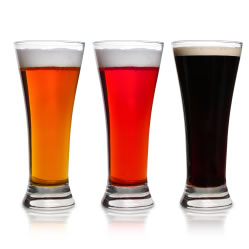
The color of beer is a vital sign of the quality of the brew. As most of us know, Beer comes in a rainbow variety of earth tones, from the blackest brown to perfect amber to pale gold. It is the color of precisely controlled levels of malting, roasting, and infusion. For centuries, to keep beer clear and pristine, brewers have developed their own special admixtures which help keep their beer free of sediment. All this invention and experimentation has produced a technology that is not only inebriating, but also flavorful, exact, and beautiful to behold in light bright or dim. The color of beer is, for many, the first indication of what it may taste like.

Many new and different beers are hitting the market, we are seeing a whole new section of the color spectrum pouring forth. With this change, a change in the way brewers judge beer color is also going to have to change. The modern brewing technique for producing the desired color of beer is called the SRM, or Standard Reference Method. This method assigns degrees of darkness varying from 2 degrees for Pale Lager to 70 degrees for Imperial Stout, and is comparable to the older Lovibond degree system. These systems measure the darkness of the ale, but not the color spectrum. Most color charts using this technique show a spectrum from black-brown through pale yellow. With the many variations modern beers offer the adventurous beer fan, the SRM is likely to be challenged by redder beers, dyed with goji or raspberries, and even Blueberry-infused ales, such as BluCreek (from Maine), Blueberry Ale from Atlantic Brewing Company (Maine), and even Sea Dog’s Blueberry Wheat.

In order for beer brewers and breweries to maintain consistent results, color management systems and formulas are going to have to change with the times. Right now, a decisive system has not been developed for measuring colors outside the normal beer spectrum, but I’m sure we can count on this happening soon – and I’m sure it is already happening in the laboratories of the breweries that are producing ales with non-traditional colors.

Dark beers are known around the globe for their rich, indeed, nutritious taste. Popular for drinking during the colder months and in colder climes, stout, porter, and barley wine aficionados carry amongst themselves the remark of “the darker the better”. The quality of the head also makes a difference to the discerning beer fan, especially in darker beers. The trick of perfect carbonation and pouring can really bring out the head in a beer. The perfect match for a dark beer is a cream colored head, approximately 1/4 – 3/8 of an inch thick. Also, the texture of the head should lean towards creamier rather than foamier. A Porter carries a SRM degree of 57, and stouts vary from 69-70. Barley Wines are usually, but not always, on the darkest side, from 57-70.

The next stage of lightness is the brown or nut brown ale. These beers are good for those who like dark beers but cannot abide by the dense nature of stouts and porters. Brown ales are part of a long standing tradition in England, where Samuel Smith’s brewery has been producing such ales since 1758, with a verifiable trademark yeast culture since 1900. Brown ales have a broad range of middlin’ color tones, SMR 23 – 39.

Lagers, Pale Ales, IPAs, and ESBs rank among the lowest degrees of SRM, from 20 down to 2 degrees.

With advances in beer brewing technology, we are entering into a stage where lighter beers are able to have more body. We are seeing very malty versions of SRM 8-25 beers, most notably the infamous Arrogant Bastard ale, and even Stone Breweries Barley Wine, Old Guardian, which usually has an SMR of around 38. As beer technologies advance even further, we are sure to see even more variety in the beer spectrum in the coming years.

Stay Healthy By Drinking Beer

Stay Healthy By Drinking Beer

Beer has a history of being prescribed as a tonic remedy for illness. Since the days of Ancient Egyptian civilization, beer has been a healthier alternative than drinking from possibly polluted water supplies. The beer we drink has come a long way from back then. Beer is now available with such fortitude that many beers are considered a meal in and of themselves. We are seeing a trend in beer marketing that labels beer as a “healthy” drink. One modern day beer manufacturer is even fortifying their ale with the vitamins to promote their “health” beer. Others are determined to produce only organic beers. There is some scientific support for this claim, but does the evidence justify all the hubub? I propose that the real keys to gaining the health benefits of drinking beer are simple: quality, and, most importantly, moderation.

Beer has been used medicinally throughout its history. Who hasn’t heard of the Irish tradition of giving an anxious child a sip of porter to help them sleep? In his book Sacred and Healing Herbal Beers, author Stephen Harrod Buhner has published numerous recipes for which our ancestors have used certain herbal beer to treat specific illnesses, from Horehound (for coughs) and Wormwood ale (for fevers) to even Borage ale and beer made with the fresh sprigs of the spruce tree. The use of beer medicinally has largely fallen off in the modern age. Scientific studies regarding such arcane recipes are not likely to come forth, but I put some stock in the technology of a time when people were closer to plants and the earth. Still, one must “use all the tools in the tool box”. So what does modern science say about drinking?

Specifically, when do we draw the line, in terms of health, when drinking beer? Certainly, beer is not healthy for everyone. Those people suffering from Hepatitis-C and other conditions that debilitate the liver, drinking alcohol of any sort is strictly unadvisable. According to the Wall Street Journal (Healthy Brew: Studies Show Beer May Be Good for You August 13, 2002) binge drinking (drinking 6 or more beers a day) can put people at risk for obesity, cancer, liver failure and stroke. But for those that drink less than that, the risk of stroke and heart disease is lessened. From the American Heart Association comes the following recommendation of moderation: according to their Dietary Guidelines, the definition of moderation is two drinks a day for men and one for non-pregnant women (a drink being defined as 12 ounces of regular beer) From this we can gather that having an average of 1-2 pints of quality beer a day might be good level of moderate drinking – enough to stimulate health in the heart without going overboard.

Some commercially produced beers in this day and age are even produced with health benefits in mind. One new brand of “healthy beer” comes from a company know as Stampede. This company’s innovation is vitamin fortified beer. With such vitamin fortifiers as Thiamine, Riboflavin, Niacin, Pyridoxine, Folic Acid, it will be interesting to see if beer drinkers are going to go for the so-called “healthy” alternative. Blu Creek’s “Zen IPA” is another product advertised with the “healthy beer” campaign. Their IPA is brewed with green tea, which contributes anti-oxidants to the brew.

Organic beers are probably your best bet for attaining real and lasting health benefits form your beer. Organic beer is made, every step of the way, with ingredients that are grown without the use of pesticides, additives, or preservatives. The result has people talking. Some friends of mine have claimed that organic beers practically cancel out the possibility of a hangover. I know, from my experience, that the taste of organic beer is superior to non-organics of the same type in many instances. But, are these ales really more beneficial for health? Or is the notion of “healthy beer” merely an advertising ploy? Either way, new and interesting brews are surfacing under the banner of “healthy beer”.

One aspect of beer drinking that contributes to moderation is the knowledge and respect of the craft that comes from home brewing. The hard work and diligence that goes into brewing beer gives the home brewer a deeper understanding of the nature of alcoholic inebriation. If you are interested in the afore-mentioned ancient healing beer recipes, home brewing is certainly the only way to try them out. Although the author of Sacred and Healing Herbal Beers is required to make the disclaimer that the recipes in his book are for “educational and historical” purposes only, I, personally, have had a great deal of enjoyment from re-creating these ancient recipes. Although I must also state that I do not advise the making, use, or ingestion of any of those beers by the reader.

The health benefits of drinking beer do seem to outweigh the negatives, for most people. Just a few beers can tip the scale, however. To stay healthy by drinking beer, remember to moderate your drinking, and have respect for the power of alcohol. Try to drink only good quality beer, organic, if you can get it, and as always, drink it in good health.

Ale without Hops

Marsh Rosemary

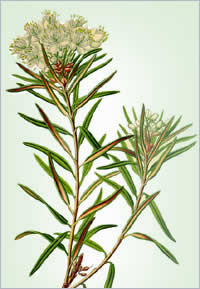
It may seem impossible, but at one time in this our world, all ale was made without hops. Beer was quite a different beverage back then. Brewers were still experimenting with large varieties of herbs, trying to find the perfect addition to their malty brews. Of the many differing herbs, it is documented that our brewing ancestors used wormwood, marsh rosemary, yarrow, nettle, sage, and more to make differently inebriating herbal beers. Now that we are living in the golden age of micro brews, brew masters all over the country have been experimenting with ancient recipes and ideas about what can make a good beer… but will hops ever be dethroned from the throne of well-loved beer ingredients?

Though it is little known, hops has not always been an ingredient for beer. In the 4,000+ year history of beer, the dominance of hopped ale has only taken place over the last 700 years or so. According to Stephen Buhner in his book Sacred and Healing Herbal Beers, one of the first uses of hops in ale was that of breweries in the Netherlands in the 14th century. Before hops took over the scene, the most popular beer was a brew known as Gruit. According to Buhner, Gruit contained many herbs that had opposite effects on the drinker than hops. Gruit ale allegedly stimulates the mind, increases sexual drive, and creates euphoria, whereas the effects of hopped ale cause drowsiness, and subdue sexual ability (even if the anti-inhibitatory effect of alcohol does cause more pick-up lines to be used).

It is doubtful that hops will ever be widely replaced by another herb, given the static tendencies of the world we live in, but there is still a market for ale without hops. Some people disdain the bitter taste hops add to beer, some dislike the sedative qualities of the plant, and a few are even allergic to hops. For this niche market, beer can be made entirely without hops. To make ale without hops, it is necessary to look at the properties that hops have that make them so ideal for brewing.

Hops have a lot of beneficial qualities for beer. Beside the flavor, which is well loved the world ‘round, the antibacterial qualities of hops helped greatly to keep ale from spoiling. This must have been a great benefit for brewers in the age before refrigeration. Curiously, the use of other herbs to help ale keep is well documented from before the age of hopped beer. So what caused the huge swing in favor of hopped ale?

Buhner links the rise in popularity of hopped ale with the Protestant movement’s anti-drug sentiments. Laws forbidding the herbs used in Gruit were among the first anti-drug laws passed into law. Little did the hopped beer advocates know at that time, but this protestant sentiment would eventually grow into the temperance movement and result in prohibition.

One ale without hops that is making a strong resurgence is Heather Ale. Heather ale is a Gruit-style ale being made with heather instead of hops. The re-introduction of heather ale started in the land of its origin, Scotland. Fraoch claims that heather ale goes back to 2,000 B.C., with a tenuous life on the fringes of society for the last 4,000 or so years. In 1986, home brew shop owner and brewer Bruce Williams found a recipe for heather ale translated from Gaelic, and has been mounting a crusade to re-introduce heather ale to the world ever since. Williams’ crusade has turned out to be quite effective. Fraoch has now become the first Gruit-style ale to go “international”, re-establishing a tradition which was almost eradicated from the world.

A Nutritional Guide to Beer

Beer has always been a source of nutrition for it’s drinkers.  The most common problem people have with beer is that it is too nutritious to be considered a mere beverage.  Beer is food, and must be considered as such in order for the avid beer drinker to maintain health.  Too much beer – just like too much food – and not enough exercise has been the downfall of many a beer fan.  The body of a beer has a great effect on it’s nutritional value, and so does the yeast used in the brewing.  First let’s look at some of the overall nutritional qualities of beer.

The most nutritious aspect of beer drinking is probably the least considered – not the malt, hops, barley, but the yeast.  Yeast sediment is uncommon in most commercially produced beers, but that doesn’t mean that the yeast isn’t there – it is.  Floating unseen in the body of the beer are the remnants of the magical creature that transforms sugar into alcohol.  Yeast remains accountable for the addition of B-complex vitamins, protein, and minerals to brews.  Most commercially produced beers have the yeast sediment rigorously strained out of it – but it is still there.  In “real ale” “live ale”, or “cask-conditioned” ales, you are likely to find a higher yeast content, as the beer is less processed.

One testament to the nutritious qualities of beer is the use of beer in certain food dishes.  In Belgium, a land where beers are many and varied, they make a dish called Carbonnade.  This is basically a beef stew, but it is made with beer instead of water!  Irish stew is another likely candidate to be spiked.  Beer is also found occasionally as a marinade (for kielbasas), as a moisturizer (beer can chicken), and is even claimed by some to tenderize meat.  I have even seen beer-based desserts on the menu at mid-scale restaurants – the most common being the Guinness Ice Cream Float.  Furthermore, the study “Effect of beer, yeast-fermented glucose, and ethanol on pancreatic enzyme secretion in healthy human subjects” conducted in 1996 suggests that the non-alcoholic part of beer, yeast fermented glucose, stimulates pancreatic enzyme production, helping the body to absorb nutrients from it’s meal.  It is likely that beer is not only nutritious, but also helps the body process other nutrients in the digestive system as well. 

Beer for desert, anyone?

To understand how beer can fit into our dietary regimens, let’s look at the nutritional qualities of a few types of beer.  Different makes of beer have different nutritional values, so we’ll have to be specific here.  We are going to select three champions from three different fields of brewing.  For the dark beers, we will choose Guinness as a popular representative.  For the amber ales, New Belgium’s Fat Tire, and for the Pale ales, Sierra Nevada’s Wheat Beer. 

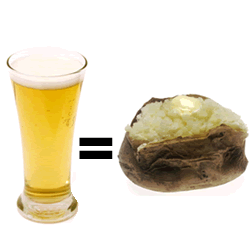
Twelve ounces of Guinness have roughly the same nutritional value as a baked sweet potato with no toppings: Sodium 20 mg. vs. 22 mg. in potato, carbs 10g vs. 12.4 g. in potato, and 40 calories worth of carbs vs. the 50 cal. sweet potato.  Guinness also has 82 cal. from alcohol (making a total of 122 cal.), and 0 g. fat, whereas the potato has 5 cal. of protein and 1 g. of fat.  As we can see, if you add a little butter, salt and pepper to the potato and the extra 4 ounces to the pint, they will come out roughly the same (although the potato will probably have more fat; the Guinness is actually quite lean).  This is a good way to look at the number of drinks you are having – a pint of Guinness is about like eating a lightly topped baked potato – but quite a bit tastier after the 2nd one.

New Belgium’s Fat Tire Amber Ale is well known for it’s full body and malty flavor.  All of that flavor does add up to more slightly more calories and carbs.  Fat Tire has a total of 155 calories and 14.7 grams worth of carbs, bringing it’s nutritional value up to that of a slightly larger baked sweet potato.  The good news is that you can easily work those extra calories off by bicycling to the bar and back!

Sierra Nevada’s Wheat Beer is a light-tasting alternative as far as beers go – but the flavors of this beer add up to more calories than Guinness!  With the same sodium content(20 mg.), and also more carbs (13.1g.), more protein (1.6g vs. Guinness 1g.), and more Alcohol 95 cal. than Guinness.  This goes to show that color isn’t everything.  Although Guinness is certainly the lightest beer, in terms of calories, from the field of Stouts.

We can see that different beers have a wide variety of nutritional values.  The one guideline I can suggest to figure out the nutritional qualities of your beer is that the more maltiness and body of the ale, the higher the caloric content is likely to be.  Keep all this in mind and keep a tally of the potato equivalent you are drinking each night.  This will help you to get the most out of your beer without getting too much!

A Guide to Barley Wines

For the serious beer fan, Barley Wines are the pinnacle achievement of the Golden Age of Microbrews.  Built to last, most barley wines are best served years after their inception date.  The many hued flavors of the barley wine are known to change, bringing out a variety of different tastes depending on when they are opened.  Some barley wines have been known to age well even after 10 years.  For this reason, many brew hobbyists collect barley wines of different vintages, as would a conessuier of fine wines.

The term Barley Wine comes from the a seasonal style of beer from England.  Usually made in the Fall or Spring, the Barley Wine would be served around October or March.  Bass Brewery was the first to coin the term commercially for their No.1 Ale, circa 1900.  The earlier version of the barley wine is generally considered to be the “Old Ale”.  According to CAMRA, the English organization for the promotion of REAL ALES old ales are a pre-industrial revolution brew that relied upon high alcohol content to keep it from turning to vinegar.  Used often as an adjunct to mixed porters to make the beer go farther.  While most barley wines are upwards of 7% alcohol, Old Ales can be classified from as low as 4%.  In current makes of Old Ale, bottle conditioning is a standard feature.

Two of the finest barley wines I have run across are the Old Guardian from Stone Brewing Company and the Bigfoot Ale from Sierra Nevada Brewing Company.  Both of these companies are based the west coast of the United States, but varieties of barley wine are brewed all over the country, and the world.  My personal experience ranks Sierra Nevada’s Bigfoot Ale as a fine collector’s item.  It seems to age well.  At a barley wine tasting I had some of a bottle that was 7 years old, a real treat.  It was fine and better tasting than the current year’s.  Old Guardian, on the other hand, has the signature hop character of the Stone Brewery, and should be best served within three years, by my knowledge of how hop character disappears with age.  It is also one of the lightest of the Barley wines currently available, so if you dislike dark beers, this would be the barley wine for you to try.

Stone breweries also occasionally makes an incredibly powerful ale called “Double Bastard”.  This ale is remarkable for its similarity to Stone’s “Arrogant Bastard” ale.  I could probably not tell the difference in a taste test, but I wouldn’t bet on it.  The shocking thing is that Double Bastard has literally DOUBLE THE ALCOHOL of Arrogant Bastard.  Truly, it is a rare and masterfully crafted ale.  While I do not know if it is marketed as a Barley Wine, it certainly deserves mention here as one of the strongest beers on the market.

One of the strongest of Barley wines is the Olde School from Dogfish Head Brewery.  This Ale comes out at a whopping 15% ABV.  Another interesting sounding product is the Bourbon Barrel Barley Wine from Sprecher Brewery.  I have had something similar, a bourbon Barrel conditioned cream porter from MacTarnahan’s Brewery.   That was a very fine ale, a special release, with vanilla and charcoal overtones and the same creamy goodness that MacTarnahan’s offers in its cream porter.

Of note in the world of barley wines are also the offerings of Anchor and Rogue Brewing Companies, both renowned for the quality of their ales.  Rouge’s Old Crustacean is sure to age well over the years, not to mention the interesting bottle, which can be displayed as a worthy drinking trophy!  Old Foghorn is Anchor’s brand, a nice dark and rich barley wine.

If you are further interested in Barley Wines, I suggest contacting your local quality liquor store and reminding them that you are interested in these specialty ales.  Start your collection today, and in the years to come you will reap the rewards that only a finely aged barley wine can offer you.

Beer, Wine, and Mead in Myth

The history and folklore surrounding beer, wine, and mead in myth is extensive.  For as long as history has been recorded, all around the world, we can see examples of these beverages being enjoyed and even fought over.  In the Bible, alcoholic drink is mentioned often.  Going further back, mead is mentioned in the ancient hymns of the Rigveda of India, poets of the Middle ages, and plays an important role in the Nordic mythology of the Eddas.  Wine goes very far back, of course, mentioned often by the philosophers of the ancient Greeks.  It could be said that, as far as we know, the arts of fermentation were among the first technologies developed by humans. 

It appears that beer may be the most ancient of beer, wine, and mead in myth – at least, as far as we know.  Beer is mentioned in the Epic of Gilgamesh, and beer has been discovered in archaeological sites to be chemically dated back to the year 5,000 BC.  Samples from pottery jars found in the cradle of civilization, what is today known as Iran, yielded these findings.  It is likely that the creation of beer goes back farther than that, but there is little evidence that has survived.  In my estimation, is has all been drunk.

Many more recent examples of the mythic legacy of beer exist – it is widely held that ancient Egyptians enjoyed beer, partially, perhaps, as a method of purifying water.   One myth surrounding beer is the ancient hymn to Ninkasi, which identifies this Sumerian Goddess as one of fermentation, dated back to around 1900 BC.  For most of recorded history, we can see this myth played out in different religious and cultural venues again and again.  Spiritualism was the explanation for everything back then, and the presence of beer, wine, and mead in myth is telling of mankind’s ubiquitous application of supernatural elements to all processes of life.  But, perhaps, the reverence with which humanity approached fermentation in ancient history is also indicative of a deeper appreciation of the experience of inebriation.  In this day and age, such appreciation is not as common, except, perhaps, among the educated – beer fans and connoisseurs.

It took a long time for brewers to discover the creature that is in actuality the cause of the fermentation process: yeast.  Before yeast was discovered, brewers in the Nordic regions would yell and shout obscenities at the beer, hoping to wake up the spirit contained within and excite it to ferment the beer.  Many monasteries during the middle ages would fervently pray over the beer, anointing it with many blessings from the Lord that He may bless the beer with the so-called “miracle” of fermentation.  This process continued for quite some time, and as the church became more and more of an institution for societal control, it became necessary for brewers to hire a priest to bless each batch of beer.  When these blessings became law, it effectively created a church rendered tax on brewing, which, I speculate, lasted in many regions of Europe until the Renaissance period.

In general, the Old Testament is in favor of drink, while the New Testament stands firmly against it (that’s old world values for you).  Never the less, wine has for many centuries played an important role in the religious rites, including that of the Jewish Bar Mitzvah, and the Catholic Eucharist and its derivatives.  There are many Hebrew words for differing kinds of wine and alcoholic beverage.  According to the Bible, Noah was a vintner, as well as Jesus (although in rapid fashion).  There are many warnings against the imbibing of wine as well, and it seems that the myths of many cultures contain this dichotomy concerning alcohol.  There is great appreciation for it, and many warnings against misuse of the beverage.

In the region now known as Mexico, Pulque, a drink similar to a wine cooler, had prohibitions against who could partake. Known among indigenous peoples as Neutle, the drink made from a mixture of fermented Agave nectar and fresh Agave nectar.  This was sometimes mixed with Peyote or other mind altering, or entheogenic plants.  Neutle was a drink reserved for the shaman and for royalty.  Severe penalties awaited those who were caught drunk who were not allowed the drink.

Mead appears most notably in Norse mythology as the tale of the mead of inspiration.  In the days of this story, Odin and his brethren (the Aesir) had made a treaty with the former rules of the heavens, the giants.  Odin had heard of the mead of inspiration, made from the blood of a god mixed with honey.  As the story goes, this mead was being guarded by either a dwarfen woman or a giantess.  Odin convinced the giantess to let him have but one sip of the mead in exchange for a night of lovemaking.  After the long night had ended, Odin took his drink, but swallowed all of the mead.  He then turned into an eagle and fled to Asgard, where he regurgitated the mead for all the Aesir to benefit from.  But as he fled from the Giantess’s house, her father in hot pursuit, some drops of the mead landed to the earth.  From these drops sprang entheogenic mushrooms, from which the poets of man gained their inspiration.

Wine is most notably apparent in the rites and myth surrounding the Greek god on Wine, Dionysus.  This God was always known as a troublemaker, being the spurned offspring of god and man, and an insufferable partier.  Like Dionysus himself, the followers of this God often were called out as rapscallions for their wine enhanced orgies and wild rites.  Known also as Bacchus to the Romans, the rites of this God were outlawed by the senate at a certain point because it was suspected that they were used as a guise to plan the overthrow of the government.  If they weren’t before, they probably were after.

This article is, of course, to short to go into much detail surrounding the presence of beer, wine, and mead in myth.  There are numerous tales of such drinks throughout the world, including Africa, Asia, Russia, and many  more countries.  The book Sacred and Healing Herbal Beers by Stephen Harrod Buhner is a good source of information concerning beer, wine, and mead in myth.  May your further researches be fruitful.

Medicinal Tonic Beers

It may be a surprise to you, but in ages past, beer has been considered to be food, a benefit to health, and even a proper medicine for ailments.  This notion seems at odds with how we see beer today.  To look further into this seeming contradiction, we must look without the scientific and ethnocentric (and entheogencentric*) disdain that many hold toward ancient practices.  To put it bluntly, what we think of today as beer is not what these ancients thought of as beer.

One of the greatest changes in commercial beer production was the German so-called “Beer Purity Law”, or The Reinheitsgebot.  This "purity requirement"(as translated literally), is a law that was first instituted in Bavaria in 1516.  It mandated that the only ingredients to be used in beer were water, hops, and barley.  It has been put forth that this law was intended to preserve wheat and rye prices at a low rate, but had many side effects for regional beers in Germany.  At this time, admixtures such as cherries, nettles, and wormwood were not unheard of, and these beers became outlawed, along with any other possible combination of herbal components.  These components were often added to beers to make them not only more palatable, but also for their medicinal or even entheogenic* qualities.

Another factor to consider, aside from admixtures, is the natural state of a finished beer back then, and now.  By back then, I mean what is called in England Real Ale.  Real Ale is served from a cask, without force carbonation, and without pasteurization.  It is, in essence, a term used to affect the preservation of ancient brewing techniques.  Real Ale is often considered to be heartier than its pasteurized, highly carbonated counterpart, and is even sometimes served warm.  There are many recipes from the 1600s and before which call for warm beer, sometimes with toast and cinnamon on top, supporting the view of beer as food.

In his book Sacred and Healing Herbal Beers, author Stephen Buhner goes into great detail about antique recipes for tonic and medicinal beers.  Many of the recipes are claimed by their authors to be cures for various types of illness, as well as to be tonics (i.e. beers that enhance general health).  In the days before the germ theory became a widely held belief that inured itself in western medical practice, most folks thought of their health a little differently: tonics were sought after as a way to promote health, instead of people being frightened by the potential presence of germs.  This same idea was revealed by Louis Pasteur himself as he lay on his deathbed, as he recanted his Germ theory as harmful to the practice of medicine.

Let us look at how this idea can be applied to beer.  The change that comes with the process of Pasteurization is important.  Before being pasteurized, beer is literally alive.  Living yeast exists in the beer, an organism which has its own defenses against harmful “Germs”.  These defenses are transferred to the beer, supplemented by the anti-bacterial properties of Hops, and protected by the proper kegging of the beer.  All this makes the beer quite a different creature from the Pasteurized, dead ales which are dominant in the U.S. and many other countries.  While the germ theory and the practice of Pasteurization help commercial interests to make money off of beer, in my opinion, these practices likely transform the beer into a less healthy beverage overall. 

These are a few manners in which the essence of beer has changed over the ages.  There still exists today the tradition of brewing real ale (as defined by CAMRA); ale that is more alive, and potentially healthier for you than most commercially produced ales.  For more information on Medicinal Tonic Beers, you can check out the books Sacred and Healing Herbal Beers by Stephen Buhner, and for more information on the U.K.’s CAMpaign for Real Ale see their website at http://www.camra.org.uk/.

*FROM WIKIPEDIA: An entheogen, in the strictest sense, is a psychoactive substance (most often some plant matter with hallucinogenic effects) which occasions a spiritual or mystical experience. In a broader sense, the word "entheogen" refers to artificial as well as natural substances which induce alterations of consciousness similar to those documented for ritual ingestion of traditional shamanic inebriants, even if used in a secular context.

A Guide to Strange and Unique Beer

One of the greatest benefits of home brewing, and of the golden age of micro brew that we are currently living in, is the ability to create new and unusual brews.  The freedom that comes with experimentation in this realm knows no bounds except those of one’s own imagination and ability.  With practice and planning, even these limits will increase, as the breadth of knowledge in these fields is naturally increasing.  As the golden age of the micro brew expands to even more unique and inventive realms, we are even seeing the list of strange and unique beer that is commercially available expand.

Micro brewers have been experimenting with unique herbal beers well into the origins of beer.  Numerous recipes are available for your edification in books such as Sacred and Healing Herbal Beers by Stephen Harrod Buhner, and Wild Fermentation by Sandy Katz.  Sacred and Healing Herbal beers is by far the most influential book on brewing that I have had the pleasure to read.  My whole career as a hobby home brewer has, in fact, been based on this book, as has that of many home brewers that I know.  It is considered in some circles to be the “bible” of strange and unique beer.

To the beer drinkers of the United States, though, even something as simple as a Belgian White Ale is often considered exotic.  While the yeasts of such ales certainly lend themselves to distinction, I wouldn’t call them unique beers.  To qualify for this category, we must take into consideration the following:

Does the beer have a unique buzz or side effect?

And;

Does the taste of the beer differ due to an admixture?

Yeast has an important effect on the taste of any beer, but this only one aspect of beer production.  The quality of the water, the types and mixtures of malts and hops, and especially herbal admixtures affect both of these factors greatly.  Inventive processes can also enhance the taste of the beer. 

Water is the highest presiding factor over the quality of a beer; it makes up roughly 90% of the beer.  I have found that the best beer I have ever been able to brew used as its base pure Alaskan glacier melt water.  The list of all-organic ingredients helped, I’m sure, although other organic ales I have drunk have almost lived up to the taste of that ale, most notably the Fishtale Organic Ale.  I would call these beers of the highest quality, and the Winter Wolf Stout that I made with the Alaskan Glacier melt water “unique” due to the process of collecting the water.

There is one commercially produced ale that I have discovered to venture into the realm of herbal admixtures, although I am sure more are to come.  I am speaking of New Belgium’s Springboard Ale.  It is an innocuous sounding name, but this ale is truly a unique herbal concoction brewed up in the guise of a Seasonal beer: a Belgian Ale with the bite of wormwood and the tonic properties of Goji berries.

The Springboard ale boldly forges ahead to reclaim space for herbal beer brewers.  Ever since the German beer purity laws, or Reinheitsgebot, adopted in 1516, and even before, the powers-that-be have sought to implement control over what manner of inebriation is allowed to the general public.  The only ingredients allowed by law in ale were water, malt, and yeast… hops were added to the list later, by popular demand.  The only other brew known to contain an active amount of wormwood ingredient is the infamous Absinthe, outlawed in the U.S. and many other countries, but still sought after and made by high class moonshiners in the United States, and, I am sure, in other countries in which its production has been outlawed.

Before the release of Springboard, the United States saw a proliferation of specialty ales – some of which contained herbs, others of which contained specialty yeasts.  A variety of Belgian Ales as well as Fraoch Heather Ale paved the way for the release of New Belgium’s Springboard by exposing the beer fans of the U.S. to more and more strange and unique beers.

In my personal experience, home brewers have been the first to experiment with wild and imaginative combinations in strange and unique beer.  I have drunk of the “Orge-Clops-Itar Ale”, containing the herb eyebright, which is regarded as a beneficial tonic for eyesight.  The brewer stated to me that the inclusion of eyebright was to help with night vision and goblin sightings.  Another unique home brew was the “Skull Crushing Hammer”, a beer made with the herb Yarrow.  The herb is said to have immense healing qualities when applied in a salve to open wounds, but when ingested, has inebriatory qualities that enhance the effect of alcohol.

Amongst home brewers is probably the best way to expose one’s self to an amazing variety of strange and unique beers.  It may not be the easiest to find home brewers bent on such strange brews, but it will certainly be a rewarding endeavor.  It might be worthwhile to enquire at your local home brew supply store about some of the “crazier” brewers that come into the shop.

When home brewing was outlawed with prohibition, it took another 50 years before the state repealed the ban on home brew, and now, finally, craft brewing is overtaking the ground it had lost over 200 years ago.  Thanks to the home brew revival, authors like Stephen Harrod Buhner and Sandy Katz, and bold brewers like New Belgium, we are sure to see a revival on the field of strange and unique beers.