Cask Ales

As interest in ancient beers and brewing techniques is piqued, the world is seeing a proliferation of the technique of serving beer as a cask-conditioned ale. Cask-conditioned ale is also referred to as “Real Ale” in some circles, although there is a subtle difference between the drinks the two terms describe. Cask Ale is a very old and traditional technique for carbonation and serving of beer. Cask Ale is currently enjoying a revival due to the qualities it imbues on the beer that it produces.

A quick summary of Cask Ale conditioning: it is a process that affects the final stage of beer production. Cask ale is un-pasteurized, un-filtered, and carbonated with the natural action of the yeast that is used in the fermentation of the ale, and without the aid of artificial carbonation or nitrogenation. Some cask ales are served with the natural yeast included, and in others the yeast has been filtered out. If the yeast has been filtered, it cannot be called a “real ale”. The concept of “Real Ale” is promoted by an association called the CAMpaign for Real Ale (CAMRA), based in the United Kingdom. According to the CAMRA’s definition, Real Ale is: "beer brewed from traditional ingredients, matured by secondary fermentation in the container from which it is dispensed, and served without the use of extraneous carbon dioxide". One method that brewers and barkeeps have discovered to keep cask ale fresh-looking and clear is to add “finings” to the cask. Home brewers will be familiar with the term “Irish moss” – this is a “fining”, an addition to the beer which causes free-floating sediment to fall to the bottom of the beer. Sometimes, cask ale is served at room temperature, but it is mostly available at cellar temperature (50 or 55 degrees) in most pubs.

Barkeeps doctoring the beer you say? One historical note about Cask Ale is that it is easy for barkeeps to do just that. In older times, barkeeps would add additional hops, finings, or even illicit herbs to doctor the beer. Some unscrupulous bar owners would take ale that was going bad and water down good ale with it and put it on sale, and others would add wormwood to the concoction to make the ale seem stronger.

Many fans of Cask Ale site their beers more subtle fizz as a main selling point. The lesser degree of carbonation, they claim, allows the more subtle flavors of their beer to be enjoyed. Guinness, the famous stout, imitates this more subtle cask ale carbonation, although by the means of different technology.

The degree of carbonation in Cask Ale is actually controlled via a device called a “soft spile”. Once the cask reaches the brew pub, the barkeep hammers this soft spile into the corked hole in the keg known as the shive. By judging the flow of foam through the soft spile, the barkeep eventually takes out the soft spile and replaces it with a hard spile, which allows no more seepage. Once this process is complete, the Cask is ready to be served, via a gravity feed.

Cask ale is becoming more and more popular in the United States, where it is still uncommon to find. The New York Times reported that one beer distributor, Union Beer Distributors, has had their accounts more than triple for cask ale sales in 2007. UBD is the leading cask ale distributor for the New York metropolitan area, and a strong indicator that cask ale is a fast growing trend, at least in New York City. Let us keep in mind that New York City sets trends internationally. Keep your eye out for cask ales at your local brew pub, you may be pleasantly surprised by this taste of the past.

Guide to Drinking Songs

Little goes better with drink than song. Especially songs that you can sing along to! Drinking songs exist the world over (many made up right on the spot), and enhance any get-together, whether folks are drinking or not. Well, it is probably better if folks are drinking. Some genres of music specialize in the drinking song. Genres such as Irish ballads, Cowboy music, Country music, Old-tyme, and even Klezmer all have a great selection of drinking songs. The best drinking songs for each occasion are the ones that are familiar to the majority of the crowd, or, are easy to pick up – so you must judge each crowd differently, whether you are playing the music on an instrument or on the stereo.

The biggest variety of drinking songs and the most well-known come from the Irish and the Irish-Americans. From many types of beer to whiskey, grog, to Poteen (Irish moonshine), this genre covers a lot of the different drinks out there. Any one interested in drinking songs should pick up the album Irish Drinking Songs – a split album with Clancy Brothers and the Dubliners. It contains many of the Irish ballads that are the best known, such as Finnegan’s Wake, All for me Grog, the Jug of Punch, Whiskey You’re the Devil, and, of course, Whiskey in the Jar. I learned many songs from these recordings, and I recommend this album as a good listen, and as a good starting point for those musicians interested in building a repertoire of drinking songs. Most of the songs are 3 or 4 chords, making the easy to learn, and are traditional songs (no copyright issues). These songs are all popular examples of the tradition of the Irish drinking song, and there are many more of equal rousing quality, although lesser known, as I discovered on my travels through Ireland.

Here is a drinking song I learned from my friend Sean, whom I met in the town Ennis in County Claire. This song is a fine example of an Irish drinking song, sung at a medium-fast pace a cappella or with accompaniment. It is a song about Puchin, which is Irish moonshine:

The Hills of Connemara (traditional)

Gather up the pots and the old tin cans
the mash, the corn, the barley and the bran
run like the devil from the excise man
Keep the smoke from rising, Barney!

Turn to the left, and turn to the right
the tall, tall men are out tonight
Drinkin’ up the tay in the broad daylight
In the hills of Connemara!

Gather up the pots and the old tin cans….

A gallon for the butcher, a quart for Tom
A bottle for the poor old father John
to help his poor old soul along
in the hills of Connemara!

Stand your ground, it is too late
the tall tall men are at the gate
Glory be to paddy, but they’re drinking it, Nate
In the hills of Connemara!

Gather up the pots and the old tin cans….

From the realm of Irish music, we see some crossover into the genres of Bluegrass and Old-Tyme Music. Songs such as Whiskey for Breakfast, and Rye Whiskey are examples of drinking songs from these genres, both with and without words. With tunes like these under your belt, you can liven up almost any party. You may not recognize Rye Whiskey by it’s name, but it is a very common tune, and only one of a few songs that share similar lyrics:

Rye Whiskey, Rye Whiskey, Rye Whiskey I cry, If I don’t have Rye whiskey I surely shall die!

You might hear this verse in a different musical circle, played with the same melody:

Oh moonshine, oh moonshine, how I love thee, you killed my old father, but, ah, you try me!

This particular song also enters the genre of Cowboy music. By “Cowboy music”, I mean old trail songs – the songs actually sung by cowboys back when driving cattle across the wide-open range. These songs differ from country music because they are songs of the people, of the workers. Cowboy songs are a mixture of folk songs and early country, but lack the fundamental principles of popular music which are an essential part of country music. Which isn’t to say that country music doesn’t have its fair share of drinking songs – it certainly does.

If a country song isn’t about being broken hearted, or even if it is, it is probably about drinking. Early country music greats Jimmie Rogers, Hank Williams, and Ernest Tubb all have a good selection of drinking songs, a tradition which has extended to nearly every country music musician since. Some modern names in country music to look out for are Lucky Tubb, and Hank Williams III.

One genre that contains drinking songs that is often over looked is that of Klezmer, a folk music which comes from the Jews of Eastern Europe. Jewish culture has no problem with drinking. Especially on certain Holy Days, one is expected to drink as part of the ceremony. The song “L’chaim”, from Fiddler on the Roof, isn’t the only Klezmer drinking song. There are quite a few songs from the Chassidic culture and Shabbes tunes as well. One well known tune is called Ma Yofus, or "Der Rabi hot geheisen freilich sein" (Avrom Goldfaden copyright 1912), which translates from the Yiddish into “the Rabbi has been drinking liquor instead of wine”.

This quick overview of drinking songs from different genres of music barely skims the surface of the variety and flavor of the world of drinking songs. Visit your local library and search online to find many more of these interesting tunes, fun to learn and to simply enjoy hearing. Cheers!

Beer Book Review

With the rise in popularity of craft, micro, and home brewing, a slew of books have come out in recent years on these subjects. Some focus on cultural aspects of beer, some on nutritional aspects, and some focus on recipes. I will go over a few of the more popular titles on the shelf today, and relate them to my personal experience.

There is a book by brew scholar and professor of brewing technology at U.C. Davis Charles W. Bamforth called Beer: Tap Into the Art and Science of Brewing, in 2003. This book goes into scientific detail about all aspects of the brewing process, with a mind to a layperson’s understanding of the topics. This is an excellent book for those interested in the details of the process of making beer. This is a good place for a starting home brewer or beer fan to learn more about what they are drinking. Professor Bamforth also gives lectures from time to time, so keep an eye out for his name in your neck of the woods. This book may be a bit simplistic for the home brewer or beer fan that is already intimately familiar with most aspects of beer production. Still, if scientific terms speak to you, it is a worthwhile read.

Radical Brewing by Randy Mosher contains a cultural overview of beer, an amusing embellished timeline of the history of beer, and many recipes. Just to give you an idea of the breadth of beer covered in this book: Corinthian Steinbier, An English Bragot, c. 1500, Juniper Rye Bock, Black Pepper Porter, and Mister Boing Boing Cherry Barley Wine are all represented, for better or worse. The book also contains recipes for beverages other than beer, such as Finnish Sahti, Mead, hop-less Gruits, and wine. Randy’s writing is one of the most palatable ingredients in Radical Brewing – witty and full of humor. I recommend this book to any brewer. Even if you prefer traditional brews, this book is sure to open your eyes, and due to the amount of recipes, a keeper as a reference manual.

The book Wild Fermentation by Sally Ellix Katz is a wild foray into a subject which, for brewers, seems very dangerous. Most brewers do not want to mess with wild yeasts, due to the ease and commercial availability of good quality ale yeasts. But this book covers much more than just beer. It covers a wide variety of foods made with the assistance of fermentation, such as vegetable ferments, dairy ferments, and even ventures into the realm of vinegar making. The book does have chapters on beer and wine as well. This book is a little much for me to handle. The chapters are compelling and informative, but it is all just too much for me to handle at once – it is like learning 5 different trades in one workshop. I recommend this book to those who are capable at multi-tasking.

My favorite book about beer, by far, is Sacred and Healing Herbal Beers by Stephen Harrod Buhner. This book is a gem containing a well-referenced codex of ancient beers from around the world. The poetry and humanitarianism with which Buhner delivers into our hands the wisdom, folklore, and recipes of the ancient brewers is both astonishing and informative. Buhner makes one particularly thrilling correlation between a beer trend that is 700 years old and political maneuvering of the protestant movement in Europe – but I won’t reveal it here because I’m not that kind of person. Buhner also writes from a fairly neutral viewpoint, taking in with deep understanding the cultures about who’s brew he is writing about. This book has been dearly loved in my home brewery, where ever it has been, and my first handed-down copy had so much wort spilled on it that I had to buy a new copy recently. This book goes over the cultural aspects of beer primarily, and also contains some bizarre recipes from the ancients – some of which taste quite good! If you are a home brewer or a fan of beer history, you must get this book.

The Brew Scholar

Brew Scholar Diploma

Brewing today is more of a science than ever. With advances in the specialty fields of micro-biotics and plant biology, this science is now receiving praise – and the degree programs – from the highest level of academia. The golden age of microbrews we are living in is giving more and more respect around the board to brewmasters, and has created a whole new field of academia – the brew scholar.

With more and more inventive and daring microbrews being created every year, we are seeing the ancient art of brewing given more and more attention. With a better understanding of what happens on the cellular level during each process of brewing – malting, mashing, fermenting, and kegging – efficient short-cuts and better ways of cleaning and sanitizing are becoming apparent. The advent of science of genetic engineering may provide even more efficient ways of fermenting beer as well. Already on the market is the product known as turbo yeast, which ferments quickly and more efficiently than most regular yeast strains. Alcohol fermented by the use of turbo yeast is used primarily as a fuel source or for distillates.

The use of Ethanol as a fuel source is growing rapidly. In Brazil, ethanol production is high, and new “flex” cars are being manufactured, which can run on either Ethanol, Gasoline, or a mixture of the two. U.S. president George W. Bush even visited there in March 7th of 2007, where he signed agreements with Brazilian president about importing alternative alcohol based technology from Brazil to the United States. The rise in value of Ethanol as an easy fuel to turn to has only increased opportunities for the Brew Scholar. After all, alcohol is most easily manufactured through the art and science of fermentation.

Speaking of which, there is a book by brew scholar and professor of brewing technology at U.C. Davis Charles W. Bamforth called Beer: Tap Into the Art and Science of Brewing. This book goes into scientific detail about all aspects of the brewing process, with a mind to a layperson’s understanding of the topics. This is an excellent book for those interested in the details of the process of making beer. This is a good place for a starting home brewer or beer fan to learn more about what they are drinking. Professor Bamforth also gives lectures from time to time, so keep an eye out for his name in your neck of the woods.

One interesting development in the birth of the brew scholar is that many respectable Universities are now offering degrees in brew science. The U.K.’s University at Nottingham has offered since 2006 a master’s course which is open to graduates as well as current brewery employees. Class topics include yeast efficiency, brewery design, and more.

At U.C. Davis, in northern-central California, malting and brewing are taught as part of the bachelor of science degree in Food Science or the master’s degree of science within the Food Science Graduate Group. This is where Professor Bamforth teaches. There are three tiers to the Davis brewing program. First is Introduction to Beer and Brewing, which gets the student familiar with the importance of beer as an international industry, and a basic understanding of how industrial breweries operate. Next is the theoretical class Malting & Brewing Science, which familiarizes the student with all aspects of industrial beer production from growing grains to the point of sale. Thirdly is Practical Malting & Brewing, where the student learns “hands-on” in the brewery and at the lab about analyzing beer and the links of that analysis with production methods.

With the golden age of microbrews going strong, it will be a wonder to see what these new brew scholars can do with beer. We are sure to see more interesting varieties and more efficient beer production thanks to these new degrees. Blue-collar workers finally have something to thank academia for!

Blackthorn's Guide to Touring Breweries

Touring Breweries

Imagine a vacation where all you did was tour breweries and sample beers from all over the nation. This kind of vacation is now possible in this country. The proliferation of microbreweries has reached such an epic proportion in the U.S. that every major city – and many smaller burgs – have breweries that offer guided tours. Naturally, not every beer fan is going to be able to convince their spouse of the fun and excitement of a brewery-tour-style vacation, but it is easily feasible to work a couple of brewery stops into the family road trip. After all, brewery tours are educational and interesting for the whole family!

Most brewery tours take place on the weekends, so make sure to take this into account with your holiday planning. Some brewery tours are free, others cost a small amount (usually $5 or so), and sometimes reservations are encouraged or required. A little research on the interweb will provide all the contact information you will need. It pays to call ahead at the brewery and ask about family, student, or elderly discounts – and to make sure that someone is there!

To determine which breweries to visit, I suggest first searching out the locations of where your favorite beers are made. Many beer companies, even microbrews, have multiple breweries. If you are planning a brewery vacation, it is easy to then connect the dots and start calling about tours in the spots you want to hit. If you have a vacation route already planned out, and have found a brewery that tours on it, you should ask the receptionist if they know of any other touring breweries in the area. In this manner, you can discover some of the local flavor, and perhaps run across your new favorite beer.

Many distilleries also offer tours of their production facilities. Perhaps the most famous of these is the Jack Daniels distillery in Lynchburg. The distillery is located about 75 miles southeast of Nashville, Tennessee, and offers 1 hour and 15 minute tours of the facility. The Jack Daniels tour incorporates informative information about the distilling process, historical anecdotes about the famous whisky, and a chance to buy commemorative bottles at their White Rabbit bottle shop. Although Moore county, where the distillery is located, is a dry county, and it forbidden to sell any form of alcohol, the distillery has a special legal dispensation to sell small commemorative bottles there.

Another fun and interesting brewery tour is that of TAKARA Sake works in Berkeley, CA. I heard from many friends about the quality of this tour for years before I was able to make it. This tour features a sake museum and an instructional video about sake making and its history. At the end of the tour, the generous hosts of TAKARA Sake treat the (21+) brewery tourists to a tasting of 11 different kinds of sake. This tour is quite a treat, and a must see for any brewery fan touring breweries in Northern California, especially the San Francisco Bay Area.

For Texans, the Shiner brewery tour is an easy jaunt. If you are interested in how a larger brewing operation works, you can visit this brewery where the daily production reaches approximately 8,000 cases of beer and 500 kegs. The Spoetzl Brewery is one of the fewer than 170 breweries in the U.S. that survived prohibition, and is still going strong to this day. As far as breweries go, this is a historical operation. Located conveniently close to San Antonio, Houston, and Austin, the Spoetzl Brewery offers tours Monday through Friday at 11 a.m. and 1:30 p.m.

The few brewery tours listed here give you some idea of the breadth and variety of brew tour adventures available to the general public. While researching your brewery tour vacation, keep an eye out for the unusual, perhaps a drink you are not used to. You will come away educated and with a greater sense of the variety and adventure available while touring breweries.

A New Kind of Ale: Third Beer

Third beer is an intriguing and new kind of beer being brewed in Japan today. Third Beer is a category of beer, which uses vagarious malt substitutes such as vegetable protein as a raw ingredient in manufacture. These new beers are mostly a product of the Japanese beer tax, which increases dramatically with the amount of malt content in the ingredients. As a result, a whole slew of beers are flooding the market, some with less than 25% malt content. But is this Third beer any good?

The term third beer is a direct reflection of the three malt categories of the Japanese beer tax system. The highest tax category is beer made with 67% or more malt content, as measured by weight of the fermentable ingredients (that would be first beer). Beers with the next level of malt content are considered low malt beers: 50 to 67%, 25 to 50%, and less than 25% – all of these are considered happoshu, or “second beer. Third beer is a beer-like beverage that contains no malt content at all.

Third beers are the result of the biggest beer companies in Japan trying to find loopholes in the beer tax laws. Sapporo, the leader in third beer innovations, spent nearly 4 years experimenting with different malt substitutes. After attaining unsatisfactory results from millet and corn, Sapporo decided on pea protein for its beverage Draft One, which appeared on the market in 2004. Part of the marketing strategy of the third beer seems similar to Smirnoff Ice. The goal is to appeal to adults that have been raised on sweet tasting sodas, and to whom the bitterness of beer is unwanted.

Instead of malt, Sapporo’s Draft One contains sugar and pea protein, in addition to yeast and hops. Advertisements boast that this beer has less carbs and more fiber. Third beer is also becoming a venue for “healthier beer” as an advertising slogan. After Draft One’s initial success in 2004, Sapporo immediately began to put forth other varieties of third beer such as their “Slims” brand. Other beer companies in Japan have jumped on the third beer bandwagon, putting out their own varieties on the theme.

Ki-rin launched their Third Beer product in 2005, Nodogoshi Nama. Their variety is made with soybean protein, and has also been financially successful, with pre-orders topping 1.6 million cases. Part of the success of the Ki-rin Brewery’s product is the “browning” technique employed to give their third beer the characteristic golden brown hue of actual beer.

Asahi is another Japanese beer company that has entered the Third Beer market. Already going strong in the Happoshu, or second beer market, Asahi’s version of Third Beer, Shin Nama, is based on a malt substitution of soy peptide.

So far, the third beer market in Japan has found little in the way of improvements that actually make any of this third beer taste better than regular beer, at least to the palate of most beer fans. The goal has been predominantly a financial one on the part of the beer companies. Never the less, bold innovations in the field of brewing have been the direct result of these financial and industrial tax evasions. Who would have ever thought that beer would some day be made of soy or pea protein? Third beer is not available for export, but, if you go to Japan, you can get it from a vending machine.

Dieting and Beer

The first thing that a dieter needs to know about beer is: beer is food. It is not a beverage you can guzzle down and not feel the caloric content of. Darker beers are, naturally, higher in caloric content than lighter beers. So if you are trying to lose some weight, start by lightening your brews – and limiting them. Mixing dieting and beer drinking is simply a question of where you put your priorities. Suddenly, a hamburger and a pint aren’t going to mix anymore.

Let’s look at the hard facts – your average beer has about 148 calories per twelve ounces. Assuming your average daily caloric intake is 2,ooo calories, this means that a couple of beers already counts as one of your meals for the day. I recommend skipping dinner.

If you are drinking darker beers, you may be in even more trouble. Some stouts rank as high as 220 calories. Compared to a light beer’s caloric content of 70-99. Surprisingly, Guinness is one exception to the dark calorie rule. Guinness ranks at a moderate 125 calories for a 12 ounce pub draught, whereas many stouts and porters are around 210. If you are not sure about how your favorite beer ranks, you can contact them and find out. Sadly, this is one area where microbrews are outperformed by the bigger brewing companies. Those microbrews just have so much flavor – and it shows in their caloric breakdown.

Now for a word about dieting. Dieting, as most people consider it, is not the healthiest way to lose weight. Suddenly changing your eating (& drinking) routine, then reverting back to the old ways a couple weeks, or a month later, is not as effective as permanent and slight changes to your routine. These changes become your permanent diet – not your two-week miracle diet. They are changes you can live with – for good. Rules are made to be broken. Most people are more likely to listen to suggestions to themselves than follow rules they make for themselves.

There are a lot of “beer diet” books going around right now. I dare say that many of these books are using the word beer just to get people to buy them. Beer has carbs, it has calories, and must be considered carefully if it is to be taken during a period of effective dieting. While beer is nutritious, it would be ludicrous to assume in any way that a beer only diet could be healthy or effective. One of the biggest difficulties facing the dieting beer drinker is just knowing which beers are high in calories, and just how much starch and carbohydrates are in each variety of beer. Fortunately, there are many calorie counter websites and books out there, and if you are unsure about the nutritional information of the beer you are drinking, it is advised to call the brewery during business hours and find out.

Being well informed is the best weapon you have in your arsenal if you want to drink beer and diet to lose weight. Adjusting your beer diet towards lighter beers with less body is an important step. Realizing that beer is food is another important step in configuring your diet. Moderation and daily routine changes are key to becoming who you want to be.

Beer Trends in 2007: a summary

Beer Trends

2007 has been an exciting time for beer. With a public increasingly interested in craft brewing, we have seen a greater variety and tendency towards experimentation from brewers. Even big brewers are now desperately trying to get a piece of the quality beer market. At a time when craft brewers are upgrading to micro-breweries, and some micro-breweries are selling so well that they can’t be called “micro” any more, the abundance these brewers are enjoying is sparking a creativity in brewing that is at an all-time high.

One unforeseen benefit of this golden age of microbrews is the revival of older, or even ancient traditions of brewing, such as cask-conditioned ales. Cask ales have increasingly come to the fore in increasingly craft-brew oriented bars from coast to coast. According to the New York Times in their article Power in the Cask: New Beers, Old Ways, one beer distributor, Union Beer Distributors, has had their accounts more than triple for cask ale sales in 2007. UBD is the leading cask ale distributor for the New York metropolitan area.

In addition to cask ales, recipes for ancient beers have been re-surfacing in the commercial market as a trend. While some varieties have been on sale for many years, such as the Trappist Ales from the monasteries of Belgium and the Netherlands, each year we are seeing more and more ancient recipes on the shelf. Fraoch, the Gruit-style Heather Ale of Scotland was perhaps the first of these ancient recipes to be re-born in a commercial venue. One of the most ancient recipes being re-created recently is Dogfish Head Breweries’ Midas Touch Golden Elixir. This beer is made from the oldest as-of-yet discovered beer of the ancients. According to the Dogfish Head website, their Midas Touch Golden Elixir contains:

“…the known ingredients of barley, white Muscat grapes, honey & saffron found in the drinking vessels in King Midas’ tomb! Somewhere between a beer, wine and mead…”

Both of these ales exemplify a distinct brewing trend apart from that of ancient beers re-incarnated, and that is hop-less ale. Hops have dominated the brewers arsenal for about 700 years, and it is only now that we are seeing the return of un-hopped ales. Before hops took over the scene, the most popular herbs used in beer were part of a concoction known as Gruit. Gruit was outlawed during the 16th to 18th centuries throughout most of Europe, but may see a resurgence, despite its euphoric, aphrodisiacal, and cerebrally stimulating properties.

Gluten-free ale is another innovation which is satisfying a niche market the world round. From Belgium comes Green’s, a brewing company that specializes in such ales in many varieties and flavors. In 2007, Green’s gluten-free ales hit the U.S. market with their blend of sorghum, rice, and millet replacing malted barley in their ales.

With all of these innovations in beer, and the new market that is popping up as a result, we are seeing even big brewing conglomerates attempting to jump on the band wagon. But big brewing companies are in a tight bind when trying to enter the high quality beer arena that has traditionally been the domain of micro breweries. Some are trying to market the same old rice padded malt beverage as a micro brew with some tricks: like adding blue food coloring to ale to try and sell their “blueberry” ale. Others are increasing their malt content for their “select” line of beers – but the slow degradation of mass produced beers has reached such a point that many people (myself included) simply cannot believe that these big corporations are capable of putting out a decent beer. One rule of thumb I have always followed is this: any beer that claims to be “best”, or a “premium” beer most certainly ISN’T. It is especially amusing to me when malt liquor is advertised as “premium”. The big brewing corporations that put out such beer have lost all credibility in the eyes of many beer fans.

It will be interesting to see how these trends develop in 2008. Will big beer corporations be able to get in on the beer-of-quality market? Will more ancient beer recipes be commercially available? Will gluten-free beer technology usurp barley? Will Gruit return to the world? All I can say is, our intentions create the world we live in.

Cooking with Beer Gaining Popularity Among Chefs

Cooking With Beer

Cooking with wine is a commonly known culinary technique, but cooking with beer is rapidly overtaking this field. While cooking with beer is traditional in many countries – Ireland, Belgium, Germany – it has just started becoming popular in the U.S within the last generation. This is a likely result of the many new varieties and flavors of beer now available in this country. In this golden age of microbrews, where more and more innovative and flavorful beers are being made commercially available, it is easy to see that cooking with beer is a growing field of the culinary arts.

My father taught me how to cook – and taught me well. I can remember the day we had sauerkraut and polish sausages for dinner. This was the first time that he showed me how beer can be used to enhance a meal, by pouring half a bottle of Pale Ale into the sausage pan and covering it. The sizzling smell of sudden maltiness added to the savory aroma of a fine quality organic sausage was – almost – intoxicating. Actually, that was probably all of the alcohol evaporating within the first 2 seconds of being poured into the hot cast iron pan.

Cooking with beer is a concept that is getting more attention. Recently, on NPR.org, Brian Miller expounded upon the use of beers of quality for cooking purposes:

“The point of adding beer is to flavor the surface and the sauces or cooking liquids (as in a stew): the stronger the beer, the more flavorful the liquid. For example, adding a Budweiser would be like pouring in tap water.”

I agree with Brian’s basic principle, but I have found, through my experience, that even a fairly light beer adds considerably more flavor than tap water.

Case in point: it was thanksgiving, and, being the predominant meat eater in our household, I took it upon myself to provide an alternative to the tofurky the vegetarians demanded for the holiday. My good friend Oops the Clown took sympathy on my plight after giving me a ride in the pouring rain after my early morning tofurky mission, and bought us a turkey on Thanksgiving day (I don’t know where she found one!). Thawing was a bit of a rush job, but turned out fine – the real problem was during cooking that I had a pan but no cover for the bird. Some of you turkey rosters may know that this is a recipe for a dry as heck bird, especially considering that I was barbequing the mother.

Fortunately, Chris the tattooed man came over with Katzen the Tiger Lady and their son Felix, and Chris always brings a 12-pack to the party (did I mention that I work in the circus sideshow?). So, religiously, every ½ hour, as the bird was cooking, I opened up a Tecate that Chris brought over and poured it over the Turkey. After 4 hours, the bird had drunk more than anyone else had, and as a result was moist and flavorful even without a cover to keep the juices in. Even a light beer can add body and flavor to a dish, and in this case, beer truly saved the day.

While beer is primarily used to flavor meat dishes, it can also be used as a glaze over grilled veggies, as an admixture to BBQ sauce or to stew. For more ideas about cooking with beer, you might want to peruse Jay Harlow’s Beer Cuisine (1991 Harlow & Ratner), Stephen Beaumont’s Brewpub Cookbook (1998 Siris), or The Brewmaster’s Table – Discovering the Pleasures of Real Beer With Real Food (2003 HarperCollins).

The Color of Beer

The Color of Beer

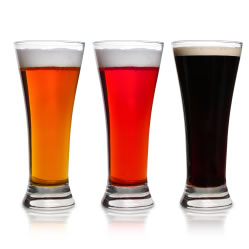
The color of beer is a vital sign of the quality of the brew. As most of us know, Beer comes in a rainbow variety of earth tones, from the blackest brown to perfect amber to pale gold. It is the color of precisely controlled levels of malting, roasting, and infusion. For centuries, to keep beer clear and pristine, brewers have developed their own special admixtures which help keep their beer free of sediment. All this invention and experimentation has produced a technology that is not only inebriating, but also flavorful, exact, and beautiful to behold in light bright or dim. The color of beer is, for many, the first indication of what it may taste like.

Many new and different beers are hitting the market, we are seeing a whole new section of the color spectrum pouring forth. With this change, a change in the way brewers judge beer color is also going to have to change. The modern brewing technique for producing the desired color of beer is called the SRM, or Standard Reference Method. This method assigns degrees of darkness varying from 2 degrees for Pale Lager to 70 degrees for Imperial Stout, and is comparable to the older Lovibond degree system. These systems measure the darkness of the ale, but not the color spectrum. Most color charts using this technique show a spectrum from black-brown through pale yellow. With the many variations modern beers offer the adventurous beer fan, the SRM is likely to be challenged by redder beers, dyed with goji or raspberries, and even Blueberry-infused ales, such as BluCreek (from Maine), Blueberry Ale from Atlantic Brewing Company (Maine), and even Sea Dog’s Blueberry Wheat.

In order for beer brewers and breweries to maintain consistent results, color management systems and formulas are going to have to change with the times. Right now, a decisive system has not been developed for measuring colors outside the normal beer spectrum, but I’m sure we can count on this happening soon – and I’m sure it is already happening in the laboratories of the breweries that are producing ales with non-traditional colors.

Dark beers are known around the globe for their rich, indeed, nutritious taste. Popular for drinking during the colder months and in colder climes, stout, porter, and barley wine aficionados carry amongst themselves the remark of “the darker the better”. The quality of the head also makes a difference to the discerning beer fan, especially in darker beers. The trick of perfect carbonation and pouring can really bring out the head in a beer. The perfect match for a dark beer is a cream colored head, approximately 1/4 – 3/8 of an inch thick. Also, the texture of the head should lean towards creamier rather than foamier. A Porter carries a SRM degree of 57, and stouts vary from 69-70. Barley Wines are usually, but not always, on the darkest side, from 57-70.

The next stage of lightness is the brown or nut brown ale. These beers are good for those who like dark beers but cannot abide by the dense nature of stouts and porters. Brown ales are part of a long standing tradition in England, where Samuel Smith’s brewery has been producing such ales since 1758, with a verifiable trademark yeast culture since 1900. Brown ales have a broad range of middlin’ color tones, SMR 23 – 39.

Lagers, Pale Ales, IPAs, and ESBs rank among the lowest degrees of SRM, from 20 down to 2 degrees.

With advances in beer brewing technology, we are entering into a stage where lighter beers are able to have more body. We are seeing very malty versions of SRM 8-25 beers, most notably the infamous Arrogant Bastard ale, and even Stone Breweries Barley Wine, Old Guardian, which usually has an SMR of around 38. As beer technologies advance even further, we are sure to see even more variety in the beer spectrum in the coming years.