Ale without Hops

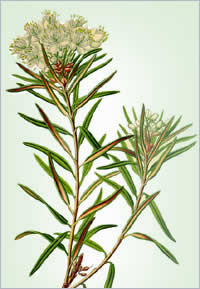
Marsh Rosemary

It may seem impossible, but at one time in this our world, all ale was made without hops. Beer was quite a different beverage back then. Brewers were still experimenting with large varieties of herbs, trying to find the perfect addition to their malty brews. Of the many differing herbs, it is documented that our brewing ancestors used wormwood, marsh rosemary, yarrow, nettle, sage, and more to make differently inebriating herbal beers. Now that we are living in the golden age of micro brews, brew masters all over the country have been experimenting with ancient recipes and ideas about what can make a good beer… but will hops ever be dethroned from the throne of well-loved beer ingredients?

Though it is little known, hops has not always been an ingredient for beer. In the 4,000+ year history of beer, the dominance of hopped ale has only taken place over the last 700 years or so. According to Stephen Buhner in his book Sacred and Healing Herbal Beers, one of the first uses of hops in ale was that of breweries in the Netherlands in the 14th century. Before hops took over the scene, the most popular beer was a brew known as Gruit. According to Buhner, Gruit contained many herbs that had opposite effects on the drinker than hops. Gruit ale allegedly stimulates the mind, increases sexual drive, and creates euphoria, whereas the effects of hopped ale cause drowsiness, and subdue sexual ability (even if the anti-inhibitatory effect of alcohol does cause more pick-up lines to be used).

It is doubtful that hops will ever be widely replaced by another herb, given the static tendencies of the world we live in, but there is still a market for ale without hops. Some people disdain the bitter taste hops add to beer, some dislike the sedative qualities of the plant, and a few are even allergic to hops. For this niche market, beer can be made entirely without hops. To make ale without hops, it is necessary to look at the properties that hops have that make them so ideal for brewing.

Hops have a lot of beneficial qualities for beer. Beside the flavor, which is well loved the world ‘round, the antibacterial qualities of hops helped greatly to keep ale from spoiling. This must have been a great benefit for brewers in the age before refrigeration. Curiously, the use of other herbs to help ale keep is well documented from before the age of hopped beer. So what caused the huge swing in favor of hopped ale?

Buhner links the rise in popularity of hopped ale with the Protestant movement’s anti-drug sentiments. Laws forbidding the herbs used in Gruit were among the first anti-drug laws passed into law. Little did the hopped beer advocates know at that time, but this protestant sentiment would eventually grow into the temperance movement and result in prohibition.

One ale without hops that is making a strong resurgence is Heather Ale. Heather ale is a Gruit-style ale being made with heather instead of hops. The re-introduction of heather ale started in the land of its origin, Scotland. Fraoch claims that heather ale goes back to 2,000 B.C., with a tenuous life on the fringes of society for the last 4,000 or so years. In 1986, home brew shop owner and brewer Bruce Williams found a recipe for heather ale translated from Gaelic, and has been mounting a crusade to re-introduce heather ale to the world ever since. Williams’ crusade has turned out to be quite effective. Fraoch has now become the first Gruit-style ale to go “international”, re-establishing a tradition which was almost eradicated from the world.
A Guide to Strange and Unique Beer

One of the greatest benefits of home brewing, and of the golden age of micro brew that we are currently living in, is the ability to create new and unusual brews.  The freedom that comes with experimentation in this realm knows no bounds except those of one’s own imagination and ability.  With practice and planning, even these limits will increase, as the breadth of knowledge in these fields is naturally increasing.  As the golden age of the micro brew expands to even more unique and inventive realms, we are even seeing the list of strange and unique beer that is commercially available expand.

Micro brewers have been experimenting with unique herbal beers well into the origins of beer.  Numerous recipes are available for your edification in books such as Sacred and Healing Herbal Beers by Stephen Harrod Buhner, and Wild Fermentation by Sandy Katz.  Sacred and Healing Herbal beers is by far the most influential book on brewing that I have had the pleasure to read.  My whole career as a hobby home brewer has, in fact, been based on this book, as has that of many home brewers that I know.  It is considered in some circles to be the “bible” of strange and unique beer.

To the beer drinkers of the United States, though, even something as simple as a Belgian White Ale is often considered exotic.  While the yeasts of such ales certainly lend themselves to distinction, I wouldn’t call them unique beers.  To qualify for this category, we must take into consideration the following:

Does the beer have a unique buzz or side effect?

And;

Does the taste of the beer differ due to an admixture?

Yeast has an important effect on the taste of any beer, but this only one aspect of beer production.  The quality of the water, the types and mixtures of malts and hops, and especially herbal admixtures affect both of these factors greatly.  Inventive processes can also enhance the taste of the beer. 

Water is the highest presiding factor over the quality of a beer; it makes up roughly 90% of the beer.  I have found that the best beer I have ever been able to brew used as its base pure Alaskan glacier melt water.  The list of all-organic ingredients helped, I’m sure, although other organic ales I have drunk have almost lived up to the taste of that ale, most notably the Fishtale Organic Ale.  I would call these beers of the highest quality, and the Winter Wolf Stout that I made with the Alaskan Glacier melt water “unique” due to the process of collecting the water.

There is one commercially produced ale that I have discovered to venture into the realm of herbal admixtures, although I am sure more are to come.  I am speaking of New Belgium’s Springboard Ale.  It is an innocuous sounding name, but this ale is truly a unique herbal concoction brewed up in the guise of a Seasonal beer: a Belgian Ale with the bite of wormwood and the tonic properties of Goji berries.

The Springboard ale boldly forges ahead to reclaim space for herbal beer brewers.  Ever since the German beer purity laws, or Reinheitsgebot, adopted in 1516, and even before, the powers-that-be have sought to implement control over what manner of inebriation is allowed to the general public.  The only ingredients allowed by law in ale were water, malt, and yeast… hops were added to the list later, by popular demand.  The only other brew known to contain an active amount of wormwood ingredient is the infamous Absinthe, outlawed in the U.S. and many other countries, but still sought after and made by high class moonshiners in the United States, and, I am sure, in other countries in which its production has been outlawed.

Before the release of Springboard, the United States saw a proliferation of specialty ales – some of which contained herbs, others of which contained specialty yeasts.  A variety of Belgian Ales as well as Fraoch Heather Ale paved the way for the release of New Belgium’s Springboard by exposing the beer fans of the U.S. to more and more strange and unique beers.

In my personal experience, home brewers have been the first to experiment with wild and imaginative combinations in strange and unique beer.  I have drunk of the “Orge-Clops-Itar Ale”, containing the herb eyebright, which is regarded as a beneficial tonic for eyesight.  The brewer stated to me that the inclusion of eyebright was to help with night vision and goblin sightings.  Another unique home brew was the “Skull Crushing Hammer”, a beer made with the herb Yarrow.  The herb is said to have immense healing qualities when applied in a salve to open wounds, but when ingested, has inebriatory qualities that enhance the effect of alcohol.

Amongst home brewers is probably the best way to expose one’s self to an amazing variety of strange and unique beers.  It may not be the easiest to find home brewers bent on such strange brews, but it will certainly be a rewarding endeavor.  It might be worthwhile to enquire at your local home brew supply store about some of the “crazier” brewers that come into the shop.

When home brewing was outlawed with prohibition, it took another 50 years before the state repealed the ban on home brew, and now, finally, craft brewing is overtaking the ground it had lost over 200 years ago.  Thanks to the home brew revival, authors like Stephen Harrod Buhner and Sandy Katz, and bold brewers like New Belgium, we are sure to see a revival on the field of strange and unique beers.

Entrepreneurship and Home Brewing

Home brewing has always been a hobby with numerous possibilities for the financial benefit of the home brewer.  With the skills and knowledge of brew craft that many home brewers have, it is easy to make the jump from a hobbyist into a career brewer.  Some brewers start by opening their own local brewpub.  Others go to one of the many schools offering degrees in Master Brewing, hoping to land a job with a larger company that produces ales of quality.  Some brewers even go underground to sell their concoctions at parties and even speakeasies.  If you are thinking of a career in brew crafting, it is wise to look at many of the entrepreneurial options available to you.  You might just find the perfect new career you have been looking for!

Many home brewers love to brew beer, but have trouble making the jump to using industrial style equipment.  If you are confused by the array of home brewing products out there, just remember: with each jump in technology, you will be able to make more beer, more efficiently, more cost effectively, and more time effectively than ever before.  It is always good to keep your old bottling tools on hand in case you want to make a special gift bottle or limited edition ale.  But for the entrepreneurial home brewer, a move to Cornelius kegs and the larger regulation kegs is an important step.

Cornelius kegs are a great way to get to know how modern beer kegging works, and to experiment with carbonation techniques.  The set-up price is relatively small, and the savings in time that would otherwise be spent bottling is vast.  Another good initial investment is the kegerator, or kegerator conversion kit. A proper knowledge of how your Cornelius keg interacts with a draft beer system will help you greatly when you switch to regulation kegs.  Cornelius kegs are becoming harder and harder to find second-hand, but they are available as brand new or reconditioned units through many home brew equipment suppliers.  

Because of the size of the Cornelius keg (about 6 gallons), it is the perfect choice for the home brewer who wishes to gradually develop their brew shop and range of knowledge.  Most home brewers start out brewing batches in that range, and this will allow home beer production to increase without the need for a larger kettle – but this is the next step!  Once you have started to keg your beer, you will find it so easy to make large amounts, that you will want to increase your kettle size to around nine gallons.  A nine-gallon kettle takes only a little more time to brew than a three or five gallon one.  Many home kitchens are not built to accommodate such massive pots, though, so you will have to plan ahead to ensure success with this increased brew load.

You should always have a spoon or stirring paddle that can easily reach the bottom of your kettle.  Kettles with false bottoms and spigots can easily facilitate the exit of the wort from the kettle, which can be a real problem if your kettle is holding in excess of five gallons.  Because of the weight of the wort, you will basically have to not move the kettle until the wort has cooled.  If you are using a wort chiller to affect this change, you should ensure that the water lines can reach the kettle where it is placed.

The most important jump for the entrepreneurial home brewer is the use of the all grain brewing technique.  By using grains, you will save money over using malty extract, and as your batches become bigger and bigger, these savings will increase exponentially.  There are some more start up costs associated with this kind of brewing, but also many shortcuts you can use while perfecting this brewing technique.  Some find it distasteful, but the use of food grade five gallon plastic buckets can replace the need for a false bottom kettle, and a cleaned and sanitized camping cooler can also help with the mashing process, where maintaining temperature is so important.  If you consider yourself a bit of an engineer, and have a lot of room to work with, the three tier brewing system is the best way to maximize the efficiency of your all grain brewing setup.

The career of a brew master is a fun, creative tradition that is enjoyable for both the brewer and the drinker!  Remember that you need not have a degree to be a master brewer, but a scientific knowledge of brewing will only make it easier to repeatedly produce the unique ale that is yours!  Remember that an eye for invention and mechanical improvisation will save you tons of time and money in this effort, and good luck!

Brewing Up a Fine Camping Trip

When planning a camping trip, most people remember to bring the tent, the sun block, and the sleeping bags.  But many folks forget that special addition that can make the trip all the more enjoyable after a long hike: the home brew!  Most camping trips can benefit from some home brewed refreshment, whether a small hike or a full-blown lake fishing trip!  With the advances in home brew serving technology these days, it can be simple for friends, families, or couples to brew up a fine camping trip!

If you are going to the lake, or on another kind of car or R.V. camping trip, bringing a larger home brew setup is a great way to enhance the trip.  If you have room in your vehicle and a generator, you can bring along your home kegerator, but most people opt for the draft beer cooler for such trips.  A draft beer cooler is basically a plastic cooler that has either a copper or stainless steel cooling coil placed inside (with lots of ice).  The beer from the kegs flows through this cooling system and out of draft spigots mounted on the front of the beer cooler, producing a cool and refreshing draft beer with a very lightweight and easy to set-up apparatus.

Either draft beer coolers or beer cooler conversion kits can be ordered online, making it even easier for you to focus on your brewing for the camping trip.  Considering the cost of keeping a generator on and kegerator plugged our whole camping trip, the draft beer cooler is a much more economical option for your camping trip.  Make sure you have extra supplies of ice for your draft beer cooler.  If the keg beer flowing through your beer lines is warm, it will melt the ice inside quickly, and it will need to be replaced.  It is a good idea to keep the kegs insulated in thick blankets to keep it cool.

For smaller camping trips, such as one to three day hikes, or walk-in camping, a smaller beer cooler with a few bottle conditioned brews can be perfect.  For colder weather hiking, a nutritious stout, porter, or malty scotch ale is recommended.  These ales will keep you warm under the crisp, cold glare of starlight in the mountains, and help you rest.  No cooler is really necessary for these trips, as an icy mountain stream will cool your bottles off rather easily.  For warmer weather trips, coolers are advised, although it may not be necessary if cold-water streams are along your path.  But for warmer weather hikes, a lighter ale is recommended, at darkest an amber.

One fun aspect of the biggest camping days of the year, namely, Labor Day, Memorial Day, and Fourth of July, is making the extra preparations necessary to build a bar for your camp out!  If you already have a home bar, you will be able to take some of your sturdier decorations out to the campground.  The main issue will be having plenty of seating available for your patrons, be they friends, family, or fellow campers.  Turning your campsite into a party zone can make you some exceptional friends!  To avoid any unpleasant interactions with authorities, it is advisable to disguise your mobile draft beer system.  You may want to read my articles Entrepreneurship and Home Brewing and Disguising a Mobile Beer Draft System if you are planning on setting up a campsite bar during such major party weekends.

Whether you are brewing up a fine camping trip for a small group, or for a large assembly, the mixture of draft keg beer and the wilderness is a pleasant surprise for all.  The association of home brew and the great outdoors is an apt one; brewing one’s own beer is healthier than accepting the bland corporate beers offered in most of the nation, and is especially refreshing after a constitutional in the great outdoors!

Fortified Ales I Have Known

One rare treat in the world of craft brewing is the fortified ale.  A fortified ale is an ale that has a hard liquor, an herbal admixture, or both added to it before kegging or bottling.  This kind of ale is mostly seen in the realm of craft brewing or home brewing.  In the days before refrigeration technology was much advanced, it was common for barkeeps to mix new ales with older ones, enhance brews with wormwood to increase their potency, and for brewers to create fortified ales as well.  Now, the fortified ale is a rare commodity indeed, but one that is rather simple for the home brewer who is equipped to keg his or her beer.

The most effective use of the fortified ale that I have experienced has been that of an herbal tincture.  This process can be used to provide both flavor and increased inebriation to any home brewed ale.  I have found Anise, Star Anise, Mugwort (both root and leaf), and wormwood to all be effective herbal admixtures for fortifying ales, but it is certainly advisable to use such sparingly, as it is easy to add too much to our brew.  You need not fear for loss of the batch in such cases, though.  Usually the bitter or acid tastes die out with some aging (6-11 months, depending on the girth of your step-step).

If you plan to create a fortified ale, it is important to realize that if alcohol is used (say, a cheap rum, herbally affected or not) to enhance the inebriatory qualities of your ale, it will be necessary to force carbonate your beverage by the use of a beer keg of some sort.  The reason for this is that when the alcohol level of the beer increases with the addition of a hard liquor to the mixture, the yeast that normally causes the carbonation effect is killed.  I have found the use of a Cornelius keg to be handy when making fortified ales at home.  Common among home brewers, the Cornelius keg offers, at a reasonable price, a great chance to try fortifying one’s own ale while maintaining a proper level of carbonation in the beverage in question.

If you have a home bar, and you are a home brewer, a fortified ale can be a great addition to your selection of seasonal ales.  A brandy enhanced amber ale for fall, perhaps?  How about a winter stout with the extra zing of mint schnapps?  I find that one liter of 80 proof alcohol enhances the five gallon home brew batch quite effectively.  I recommend adding to this liter an herbal admixture of some kind to make your fortified ale truly special.  If you are brewing for summer, an apricot, cherry, strawberry, or apple infused rum could add that special something you are looking for.  The method of fortifying ales with special liquor is one that is seldom practiced among home or craft brewers – a chance to try something unique and different.

Many microbrewers these days are trying all kinds of admixtures for their ales, from Rogue’s Hazelnut Brown (Highly recommended), to Laguinitas with their Brown Suggah (made with molasses, very strong), to New Belgium’s Springboard Ale (fortified with a pinch of wormwood).  There are new concoctions coming out every month, it seems, and the atmosphere is ripe in the craft brewing world to bring forth the next level of unique brews: the fortified ale.

Kegerator Upgrade: Single Tap to a Double Tap Tower

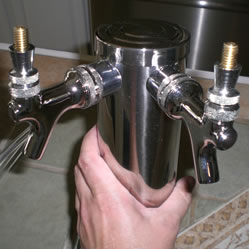
Double Tap Tower

When buying your first kegerator, most of us opt for the cheapest solution available. This is very understandable, as the cost of a kegerator is rather expensive, but keep in mind that you may want to upgrade your kegerator later down the road.

Take for example that I bought a single tap tower kegerator about two years ago and only used it for commercial kegs for gatherings and parties. Now that I have entered the world of home brewing there has been many opportunities for me to utilize my kegerator as a storage, chilling and dispensing tool.

The home brew kegs I use to keg my beer have a different type of tapping mechanism, so I was forced to make the decision to switch the coupler from the commercial style to a ball lock sytem for use with my home brew kegs or to upgrade the entire kegerator into a dual dispensing system.

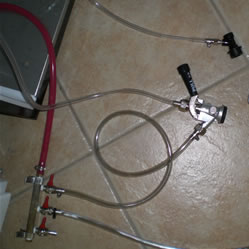
Commercial and Ball Lock Setup

The choice was easy, I wanted both. It took only a few parts for me to convert the kegerator from a single tap to a dual tap tower and while I was in there I decided to add a 3 way gas splitter. This will allow me to add a third tower later if I need it.

So I now have a dual tap system that can dispense commercial and home brew kegs. To check out some of the equipment I used see the following:

3-Way Distribution Distributor
Double Tap Tower
Ball Lock – Liquid
Ball Lock – Gas