A Nutritional Guide to Beer

Beer has always been a source of nutrition for it’s drinkers.  The most common problem people have with beer is that it is too nutritious to be considered a mere beverage.  Beer is food, and must be considered as such in order for the avid beer drinker to maintain health.  Too much beer – just like too much food – and not enough exercise has been the downfall of many a beer fan.  The body of a beer has a great effect on it’s nutritional value, and so does the yeast used in the brewing.  First let’s look at some of the overall nutritional qualities of beer.

The most nutritious aspect of beer drinking is probably the least considered – not the malt, hops, barley, but the yeast.  Yeast sediment is uncommon in most commercially produced beers, but that doesn’t mean that the yeast isn’t there – it is.  Floating unseen in the body of the beer are the remnants of the magical creature that transforms sugar into alcohol.  Yeast remains accountable for the addition of B-complex vitamins, protein, and minerals to brews.  Most commercially produced beers have the yeast sediment rigorously strained out of it – but it is still there.  In “real ale” “live ale”, or “cask-conditioned” ales, you are likely to find a higher yeast content, as the beer is less processed.

One testament to the nutritious qualities of beer is the use of beer in certain food dishes.  In Belgium, a land where beers are many and varied, they make a dish called Carbonnade.  This is basically a beef stew, but it is made with beer instead of water!  Irish stew is another likely candidate to be spiked.  Beer is also found occasionally as a marinade (for kielbasas), as a moisturizer (beer can chicken), and is even claimed by some to tenderize meat.  I have even seen beer-based desserts on the menu at mid-scale restaurants – the most common being the Guinness Ice Cream Float.  Furthermore, the study “Effect of beer, yeast-fermented glucose, and ethanol on pancreatic enzyme secretion in healthy human subjects” conducted in 1996 suggests that the non-alcoholic part of beer, yeast fermented glucose, stimulates pancreatic enzyme production, helping the body to absorb nutrients from it’s meal.  It is likely that beer is not only nutritious, but also helps the body process other nutrients in the digestive system as well. 

Beer for desert, anyone?

To understand how beer can fit into our dietary regimens, let’s look at the nutritional qualities of a few types of beer.  Different makes of beer have different nutritional values, so we’ll have to be specific here.  We are going to select three champions from three different fields of brewing.  For the dark beers, we will choose Guinness as a popular representative.  For the amber ales, New Belgium’s Fat Tire, and for the Pale ales, Sierra Nevada’s Wheat Beer. 

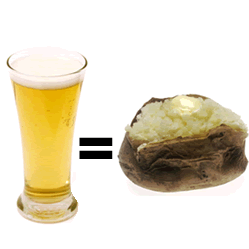
Twelve ounces of Guinness have roughly the same nutritional value as a baked sweet potato with no toppings: Sodium 20 mg. vs. 22 mg. in potato, carbs 10g vs. 12.4 g. in potato, and 40 calories worth of carbs vs. the 50 cal. sweet potato.  Guinness also has 82 cal. from alcohol (making a total of 122 cal.), and 0 g. fat, whereas the potato has 5 cal. of protein and 1 g. of fat.  As we can see, if you add a little butter, salt and pepper to the potato and the extra 4 ounces to the pint, they will come out roughly the same (although the potato will probably have more fat; the Guinness is actually quite lean).  This is a good way to look at the number of drinks you are having – a pint of Guinness is about like eating a lightly topped baked potato – but quite a bit tastier after the 2nd one.

New Belgium’s Fat Tire Amber Ale is well known for it’s full body and malty flavor.  All of that flavor does add up to more slightly more calories and carbs.  Fat Tire has a total of 155 calories and 14.7 grams worth of carbs, bringing it’s nutritional value up to that of a slightly larger baked sweet potato.  The good news is that you can easily work those extra calories off by bicycling to the bar and back!

Sierra Nevada’s Wheat Beer is a light-tasting alternative as far as beers go – but the flavors of this beer add up to more calories than Guinness!  With the same sodium content(20 mg.), and also more carbs (13.1g.), more protein (1.6g vs. Guinness 1g.), and more Alcohol 95 cal. than Guinness.  This goes to show that color isn’t everything.  Although Guinness is certainly the lightest beer, in terms of calories, from the field of Stouts.

We can see that different beers have a wide variety of nutritional values.  The one guideline I can suggest to figure out the nutritional qualities of your beer is that the more maltiness and body of the ale, the higher the caloric content is likely to be.  Keep all this in mind and keep a tally of the potato equivalent you are drinking each night.  This will help you to get the most out of your beer without getting too much!

A Guide to Mead

The mention of the word mead brings to mind images of fierce Nordic warriors at a feast hall consuming mutton.  In reality, mead is an ancient beverage, but a good quality mead is more like a fine white wine – a refined beverage.  The mixture of water, honey, and yeast, mead is a beverage that takes patience to brew.  The full fermentation cycle of a mead usually runs at about a year.  Bottling a mead sooner will usually endanger the bottle with explosion unless it is pasteurized.  On top of that, proper aging brings out even more of the subtle characteristics of the mead, making mead a prime candidate for collecting and aging.

When purchasing mead in the store, you should be careful to note the ingredients in the alleged “mead”.  Some companies produce white wine with just some honey added and call this “honey wine” or even “meade” – this is not mead, it is merely honey-sweetened wine.  Now, don’t get me wrong – there are many types of mead, including that made with grapes – but unless the honey has been fermented, it is not mead.  A simple addition of honey as a sweetener does not count.  Many people may still refer to a real mead as a honey wine as a descriptive term, however.

Many of the offshoots of mead are quite delectable, and no guide to mead would be complete without their mention.  There is cyser, which is a delectable combination of mead and hard cider.  This drink is especially enhanced by the addition of a bottle-conditioned piece of candied ginger on the bottom.  A little more savory than the worm in the tequila bottle, no?  Although, in this case, the cyser would also be a metheglin.  Metheglin is any kind of mead that has herbs or spices added, such as a mead flavored with clove, nutmeg, and cinnamon – which could be called a wassail metheglin I suppose.  This might be nice served hot!  The proper nomenclature for a cyser with such spices could be apple metheglin or simply spiced cyser.

One of the earliest ales was actually a mead.  Made first with honey and hops, later malt was added as an adjunct and eventually replaced the honey all together.  This kind of mead, or early ale is referred to as Braggot.  Another mead combination is that of honey and grapes, creating a kind of honey-wine mixture that is called Pyment, and either white or red grapes are used, depending on taste.  Some of the fine meads I have tasted are very similar to a fine wine, so I do not doubt that this combination is tasty.

There are many more possibilities, of course, but in any case where mead is mixed with fruit, the resultant drink may be referred to as Melomel.  This encompasses cyser, Pyment, and Morat (mead with mulberries).  The reason why so many meads have adjunct fruits is that yeast finds it difficult to take root in a true mead.  In addition to fruits and even grains and malt, some meads are made with the further addition of flower petals (could be considered a metheglin) such as roses, morning glory, and honeysuckle.

It is always possible for you to flavor your mead after buying it.  You can simply spice your mead for a mulled mead experience, add some candied ginger as recommended above, or even put a slice of apple or strawberries right in the bottle!  Allowing a month or so for these flavor to seep into your mead will greatly enhance the drink and personalize it, making for a fine gift idea or just to share with friends.  Mead is an exotic beverage as it is, but with your own special touch, it is sure to be a flavor to remember.

The Rebirth of the Speakeasy

If you are tired of paying $4+ for a beer at a bar, you aren’t the only one.  As more and more taxes are heaped upon drinks and transportation costs increasing dramatically, we are likely to see even steeper prices charged at the legitimate bar.  Most folks end up buying beer and drinking it at home or in the backyard, but there is something about the socialization that comes with going to the bar that a lot of folks can’t do without.  The point is having fun, not just drinking oneself into oblivion.  Still, to this day, there is indeed prohibition on many kinds of alcohol, such as absinthe.  So, naturally, the result of all this is the resurgence of the speakeasy.

My first experience with the modern speakeasy was one not unlike other bar experiences, but much enhanced exquisitely by the freedom of such a temporary autonomous zone.  The scene was similar to a house party, except that the home bar was exquisitely decorated in red and black velvet, bleached bones, and a kind of green haze in the air.  Naturally, smoking is allowed at such a speakeasy – another reason for the popularity of this event, as most states or big cities have outlawed smoking in bars.  The green was being reflected off of the bottles of Absinthe lining the walls and the milky green drinks being sipped by those in attendance, dressed in either black lace or leather, almost exclusively it seemed.  I was in the leather crowd.

Event, you say?  Yes, by necessity, the modern speakeasy is an event, not a place.  Or rather, a place that is recreated in a different location each time.  It seems that those “in-the-know” were the only ones there, and that the main way people found out about the speakeasy was word of mouth.  Usually the location is kept secret until the night before the event, and then word spreads quickly.  The speakeasy usually doesn’t even open until after other bars are closed, sometime after 2 AM.   All these are signs of a truly underground party scene.

The modern speakeasy will usually have many varieties of home brewed beverages available.  Among the beers I have seen are a raspberry porter and a pale ale, and even mead was available on tap.  The beverages are usually served chilled, from the spout of a homemade kegerator conversion.  Absinthe is sometimes available, either tidy or traditionally mixed with water and sugar.  I like both versions, and I may go in for the stronger stuff as the night progresses.  The exciting thing about the traditional absinthe is that it is served with a live flame on top of the glass, and you must blow it out before drinking – this is reminiscent of an episode of the Simpsons where Homer brews a similarly combustible drink – the “Flaming Homer”.  Straight absinthe is not recommended for anyone but those who have iron gullets and enjoy EXTREMELY bitter flavors.

I have been pleased with the cleanliness and order of the speakeasies I have visited – there is always a bar back to wash glasses and the drinks are nicely displayed.  There were a number of liquors lining the back of the bar at the first speakeasy I went to, and not only were they green, but also clear, blue, yellow, and golden brown.  I was only to find out later about some of these bottles, when I happened upon this same speakeasy again.

The speakeasy bar was nicely built and accessorized.  Plenty of pint glasses and specialty glasses were available for the absinthe, something like a large brandy snifter.  Towels, napkins, and peanuts were all available as well.  Other home bar speakeasies I have encountered have been much cruder than this set-up, merely with Cornelius kegs a-float in ice, with plastic cups.  More of a large crazy party scene.  One thing you can count on with these home bar speakeasies is that the barkeep will have something special under the table.  At times I have found t to Absinthe, Mugwort Liqueur, or Anise Liquor, so if you find yourself at one, you should ask about any specials available.  It was in this manner that I first tasted a truly fine whisky – a rare treat, but still cheap at $10 a shot.  The sweetness of it put it in a whole other category from what I had ever tasted before, and it had a kind of oily taste, hinting of vanilla, that only brought the term “snake liquor” to mind… and I could see why whisky got its reputation.

If you are eager to attend a home bar speakeasy, I recommend keeping your ears open and exploring different party scenes.  You just might get the tip off that will greatly enhance your night.  Or, barring that, why not build your own home bar?  That way, you can enjoy all the benefits of a speakeasy without the potentially nasty legal implications.  And as always, drink in good health.

A Guide to Barley Wines

For the serious beer fan, Barley Wines are the pinnacle achievement of the Golden Age of Microbrews.  Built to last, most barley wines are best served years after their inception date.  The many hued flavors of the barley wine are known to change, bringing out a variety of different tastes depending on when they are opened.  Some barley wines have been known to age well even after 10 years.  For this reason, many brew hobbyists collect barley wines of different vintages, as would a conessuier of fine wines.

The term Barley Wine comes from the a seasonal style of beer from England.  Usually made in the Fall or Spring, the Barley Wine would be served around October or March.  Bass Brewery was the first to coin the term commercially for their No.1 Ale, circa 1900.  The earlier version of the barley wine is generally considered to be the “Old Ale”.  According to CAMRA, the English organization for the promotion of REAL ALES old ales are a pre-industrial revolution brew that relied upon high alcohol content to keep it from turning to vinegar.  Used often as an adjunct to mixed porters to make the beer go farther.  While most barley wines are upwards of 7% alcohol, Old Ales can be classified from as low as 4%.  In current makes of Old Ale, bottle conditioning is a standard feature.

Two of the finest barley wines I have run across are the Old Guardian from Stone Brewing Company and the Bigfoot Ale from Sierra Nevada Brewing Company.  Both of these companies are based the west coast of the United States, but varieties of barley wine are brewed all over the country, and the world.  My personal experience ranks Sierra Nevada’s Bigfoot Ale as a fine collector’s item.  It seems to age well.  At a barley wine tasting I had some of a bottle that was 7 years old, a real treat.  It was fine and better tasting than the current year’s.  Old Guardian, on the other hand, has the signature hop character of the Stone Brewery, and should be best served within three years, by my knowledge of how hop character disappears with age.  It is also one of the lightest of the Barley wines currently available, so if you dislike dark beers, this would be the barley wine for you to try.

Stone breweries also occasionally makes an incredibly powerful ale called “Double Bastard”.  This ale is remarkable for its similarity to Stone’s “Arrogant Bastard” ale.  I could probably not tell the difference in a taste test, but I wouldn’t bet on it.  The shocking thing is that Double Bastard has literally DOUBLE THE ALCOHOL of Arrogant Bastard.  Truly, it is a rare and masterfully crafted ale.  While I do not know if it is marketed as a Barley Wine, it certainly deserves mention here as one of the strongest beers on the market.

One of the strongest of Barley wines is the Olde School from Dogfish Head Brewery.  This Ale comes out at a whopping 15% ABV.  Another interesting sounding product is the Bourbon Barrel Barley Wine from Sprecher Brewery.  I have had something similar, a bourbon Barrel conditioned cream porter from MacTarnahan’s Brewery.   That was a very fine ale, a special release, with vanilla and charcoal overtones and the same creamy goodness that MacTarnahan’s offers in its cream porter.

Of note in the world of barley wines are also the offerings of Anchor and Rogue Brewing Companies, both renowned for the quality of their ales.  Rouge’s Old Crustacean is sure to age well over the years, not to mention the interesting bottle, which can be displayed as a worthy drinking trophy!  Old Foghorn is Anchor’s brand, a nice dark and rich barley wine.

If you are further interested in Barley Wines, I suggest contacting your local quality liquor store and reminding them that you are interested in these specialty ales.  Start your collection today, and in the years to come you will reap the rewards that only a finely aged barley wine can offer you.

Beer, Wine, and Mead in Myth

The history and folklore surrounding beer, wine, and mead in myth is extensive.  For as long as history has been recorded, all around the world, we can see examples of these beverages being enjoyed and even fought over.  In the Bible, alcoholic drink is mentioned often.  Going further back, mead is mentioned in the ancient hymns of the Rigveda of India, poets of the Middle ages, and plays an important role in the Nordic mythology of the Eddas.  Wine goes very far back, of course, mentioned often by the philosophers of the ancient Greeks.  It could be said that, as far as we know, the arts of fermentation were among the first technologies developed by humans. 

It appears that beer may be the most ancient of beer, wine, and mead in myth – at least, as far as we know.  Beer is mentioned in the Epic of Gilgamesh, and beer has been discovered in archaeological sites to be chemically dated back to the year 5,000 BC.  Samples from pottery jars found in the cradle of civilization, what is today known as Iran, yielded these findings.  It is likely that the creation of beer goes back farther than that, but there is little evidence that has survived.  In my estimation, is has all been drunk.

Many more recent examples of the mythic legacy of beer exist – it is widely held that ancient Egyptians enjoyed beer, partially, perhaps, as a method of purifying water.   One myth surrounding beer is the ancient hymn to Ninkasi, which identifies this Sumerian Goddess as one of fermentation, dated back to around 1900 BC.  For most of recorded history, we can see this myth played out in different religious and cultural venues again and again.  Spiritualism was the explanation for everything back then, and the presence of beer, wine, and mead in myth is telling of mankind’s ubiquitous application of supernatural elements to all processes of life.  But, perhaps, the reverence with which humanity approached fermentation in ancient history is also indicative of a deeper appreciation of the experience of inebriation.  In this day and age, such appreciation is not as common, except, perhaps, among the educated – beer fans and connoisseurs.

It took a long time for brewers to discover the creature that is in actuality the cause of the fermentation process: yeast.  Before yeast was discovered, brewers in the Nordic regions would yell and shout obscenities at the beer, hoping to wake up the spirit contained within and excite it to ferment the beer.  Many monasteries during the middle ages would fervently pray over the beer, anointing it with many blessings from the Lord that He may bless the beer with the so-called “miracle” of fermentation.  This process continued for quite some time, and as the church became more and more of an institution for societal control, it became necessary for brewers to hire a priest to bless each batch of beer.  When these blessings became law, it effectively created a church rendered tax on brewing, which, I speculate, lasted in many regions of Europe until the Renaissance period.

In general, the Old Testament is in favor of drink, while the New Testament stands firmly against it (that’s old world values for you).  Never the less, wine has for many centuries played an important role in the religious rites, including that of the Jewish Bar Mitzvah, and the Catholic Eucharist and its derivatives.  There are many Hebrew words for differing kinds of wine and alcoholic beverage.  According to the Bible, Noah was a vintner, as well as Jesus (although in rapid fashion).  There are many warnings against the imbibing of wine as well, and it seems that the myths of many cultures contain this dichotomy concerning alcohol.  There is great appreciation for it, and many warnings against misuse of the beverage.

In the region now known as Mexico, Pulque, a drink similar to a wine cooler, had prohibitions against who could partake. Known among indigenous peoples as Neutle, the drink made from a mixture of fermented Agave nectar and fresh Agave nectar.  This was sometimes mixed with Peyote or other mind altering, or entheogenic plants.  Neutle was a drink reserved for the shaman and for royalty.  Severe penalties awaited those who were caught drunk who were not allowed the drink.

Mead appears most notably in Norse mythology as the tale of the mead of inspiration.  In the days of this story, Odin and his brethren (the Aesir) had made a treaty with the former rules of the heavens, the giants.  Odin had heard of the mead of inspiration, made from the blood of a god mixed with honey.  As the story goes, this mead was being guarded by either a dwarfen woman or a giantess.  Odin convinced the giantess to let him have but one sip of the mead in exchange for a night of lovemaking.  After the long night had ended, Odin took his drink, but swallowed all of the mead.  He then turned into an eagle and fled to Asgard, where he regurgitated the mead for all the Aesir to benefit from.  But as he fled from the Giantess’s house, her father in hot pursuit, some drops of the mead landed to the earth.  From these drops sprang entheogenic mushrooms, from which the poets of man gained their inspiration.

Wine is most notably apparent in the rites and myth surrounding the Greek god on Wine, Dionysus.  This God was always known as a troublemaker, being the spurned offspring of god and man, and an insufferable partier.  Like Dionysus himself, the followers of this God often were called out as rapscallions for their wine enhanced orgies and wild rites.  Known also as Bacchus to the Romans, the rites of this God were outlawed by the senate at a certain point because it was suspected that they were used as a guise to plan the overthrow of the government.  If they weren’t before, they probably were after.

This article is, of course, to short to go into much detail surrounding the presence of beer, wine, and mead in myth.  There are numerous tales of such drinks throughout the world, including Africa, Asia, Russia, and many  more countries.  The book Sacred and Healing Herbal Beers by Stephen Harrod Buhner is a good source of information concerning beer, wine, and mead in myth.  May your further researches be fruitful.

Medicinal Tonic Beers

It may be a surprise to you, but in ages past, beer has been considered to be food, a benefit to health, and even a proper medicine for ailments.  This notion seems at odds with how we see beer today.  To look further into this seeming contradiction, we must look without the scientific and ethnocentric (and entheogencentric*) disdain that many hold toward ancient practices.  To put it bluntly, what we think of today as beer is not what these ancients thought of as beer.

One of the greatest changes in commercial beer production was the German so-called “Beer Purity Law”, or The Reinheitsgebot.  This "purity requirement"(as translated literally), is a law that was first instituted in Bavaria in 1516.  It mandated that the only ingredients to be used in beer were water, hops, and barley.  It has been put forth that this law was intended to preserve wheat and rye prices at a low rate, but had many side effects for regional beers in Germany.  At this time, admixtures such as cherries, nettles, and wormwood were not unheard of, and these beers became outlawed, along with any other possible combination of herbal components.  These components were often added to beers to make them not only more palatable, but also for their medicinal or even entheogenic* qualities.

Another factor to consider, aside from admixtures, is the natural state of a finished beer back then, and now.  By back then, I mean what is called in England Real Ale.  Real Ale is served from a cask, without force carbonation, and without pasteurization.  It is, in essence, a term used to affect the preservation of ancient brewing techniques.  Real Ale is often considered to be heartier than its pasteurized, highly carbonated counterpart, and is even sometimes served warm.  There are many recipes from the 1600s and before which call for warm beer, sometimes with toast and cinnamon on top, supporting the view of beer as food.

In his book Sacred and Healing Herbal Beers, author Stephen Buhner goes into great detail about antique recipes for tonic and medicinal beers.  Many of the recipes are claimed by their authors to be cures for various types of illness, as well as to be tonics (i.e. beers that enhance general health).  In the days before the germ theory became a widely held belief that inured itself in western medical practice, most folks thought of their health a little differently: tonics were sought after as a way to promote health, instead of people being frightened by the potential presence of germs.  This same idea was revealed by Louis Pasteur himself as he lay on his deathbed, as he recanted his Germ theory as harmful to the practice of medicine.

Let us look at how this idea can be applied to beer.  The change that comes with the process of Pasteurization is important.  Before being pasteurized, beer is literally alive.  Living yeast exists in the beer, an organism which has its own defenses against harmful “Germs”.  These defenses are transferred to the beer, supplemented by the anti-bacterial properties of Hops, and protected by the proper kegging of the beer.  All this makes the beer quite a different creature from the Pasteurized, dead ales which are dominant in the U.S. and many other countries.  While the germ theory and the practice of Pasteurization help commercial interests to make money off of beer, in my opinion, these practices likely transform the beer into a less healthy beverage overall. 

These are a few manners in which the essence of beer has changed over the ages.  There still exists today the tradition of brewing real ale (as defined by CAMRA); ale that is more alive, and potentially healthier for you than most commercially produced ales.  For more information on Medicinal Tonic Beers, you can check out the books Sacred and Healing Herbal Beers by Stephen Buhner, and for more information on the U.K.’s CAMpaign for Real Ale see their website at http://www.camra.org.uk/.

*FROM WIKIPEDIA: An entheogen, in the strictest sense, is a psychoactive substance (most often some plant matter with hallucinogenic effects) which occasions a spiritual or mystical experience. In a broader sense, the word "entheogen" refers to artificial as well as natural substances which induce alterations of consciousness similar to those documented for ritual ingestion of traditional shamanic inebriants, even if used in a secular context.

Free Beer: A Most Excellent Promotional Tool

There is little that can generate more interest in your business that the words “FREE BEER” in lights. Indeed, the whole notion of “FREE BEER” is like unto a mystical occurrence in the mind of the average Joe (slack). With such a lure, a canny business can elicit memberships (it has its privileges: FREE BEER!), marketing data such as surveys, email addresses, telephone numbers – really, the potential is nearly unlimited. It is a shame that more businesses do not realize the power of FREE BEER.

Think of the cost, some might say. If you are worried about cost, you are thinking about this all wrong. What is the true cost of offering free beer when, for example, you are asking for half a day’s labor out of someone as a volunteer or intern? Your cost in wages would be far over that of some FREE BEER, even if you buy good quality ale. I have known corporations that have enlisted numerous volunteers for weeks long work “parties” in demanding physical conditions simply for the sake of FREE BEER. Not only do volunteers flock to the event site, but the guarantee of FREE BEER elicits such trust and dedication from volunteers that those seeking financial compensation for their work are looked down upon. For most physical laborers, FREE BEER is indeed all that is needed to ensure their loyalty.

Compare Kegerators

One great way to increase the customer base of a membership-only business is the offering of “FREE BEER ON SUNDAY! (For members)”. You need not offer more than one beer per customer, but the enticing offer will lure many people into your video or canoe rental. Since the offer is only available to those who pass your membership criteria, any unsavory looking (or smelling) characters can be denied beer on the grounds that they do not have a membership with your organization.

Handling the FREE BEER promotional tool legally and efficiently is the key to its success. ID must be asked at all times. Remember that just one free beer handed to a minor can enlist a fine upwards of $2,000, plus probably the end of your FREE BEER policy. To keep things efficient, it is wise to put up either a one or two beer limit per customer. To further tighten the belt on your FREE BEER budget, you should consider the duration that you will be offering it. If, after a trial period of two months, the FREE BEER is working for your business, it is wise to invest in a kegerator. This will keep your keg from souring, and is a more efficient way of keeping beer cool and ready to drink than buying bags of ice or even if you own an ice machine. Kegerators usually pay for themselves within a matter of a year, and ensure that the beer served will be a most enjoyable pub draught.

Another application of FREE BEER is the company event or sale. Sales are enticing, but sales with FREE BEER are guaranteed to hook you in at least an extra 10% – 100% in impulse walk-in customers if advertised properly. By properly, I mean, of course, in large type facing oncoming traffic, but in the storefront will certainly suffice. Of course, the sign should say “SALE! FREE BEER! (For customers)” to leave you and your employees an out for serving beer to unsavory characters.

I am sure that by now you have realized how eye-catching this promotional tool is. For the small business owner, the chain operator, or the corporate event planner, FREE BEER should always be considered as one of the most effective promotional tools available.

Bar Tricks, Jokes, and Legerdemain

Have you ever gone out to the bar and ended up sitting on your ass watching T.V.? What a waste of an evening! The proper way to enjoy the atmosphere of any bar, be it a night of celebration or merely bar hopping, is to come prepared. By bringing with you a few bar tricks up your sleeve, taking the time to memorize a few lines worth of jokes, and a quick smile, you can not only have an amazing time at the bar, but also become the center of the party! Don’t let your bar experience leave you with a bland evening. Here are some tips for the practical art of beginning legerdemain:

Bar Tricks, Jokes, and Legerdemain

First off, remember, that as the night goes on, people are getting more and more wasted. So if your bar tricks aren’t very good at first, just start your evening out later. Take an hour or so to practice card tricks and read up on stupid jokes before you go out. Often, the only difference between a good joke and a bad one is timing. It doesn’t really matter what the joke is (remember… timing!), and also, as the night goes on, the same joke will become funnier to people that have already heard it. This is known as one of the basic concepts of comedy: Repetition is the key to humor. Timing and repetition. Repetition and timing are the keys to humor!

So now that you have a few jokes memorized, don’t forget to practice some sleight of hand (a type of legerdemain). Some basic palming can get you pretty far (making coins appear from ears, in drinks, etc), but a card counting trick will get you farther. One of the best ways to get people to buy you drinks is to place bets on whether you can pull a trick off. Your pocket book may suffer for this, of course, unless you are practiced. Remember that the trick can be a simple as folding a $20 bill to show the twin towers burning to hammering a nail into your face (a trick that is dangerous and takes training and practice: DON’T TRY THIS AT HOME, KIDS!!!). Presentation is everything.

Here is one effective act of bar legerdemain (in other words, a bar trick) that anyone can do:

Turning a One-Dollar Bill Into a Five

I first saw performed by the showman David Apocalypse as he was talking up a crowd. First off, you have to start up some conversation. A bad joke is good for this. Maybe mention some magic act you have seen. Once you spark some interest, make a friendly wager: ‘I can turn a dollar bill into a five”, you say, “Buy me a drink and I’ll show you how.”

Most folks will be hooked by this line. So you get a dollar bill from them, and start talking about this and that, maybe roll up your sleeves, all the while rolling the bill tightly in a diagonal fashion, maybe unrolling it and rolling it long ways, chatting up your audience with another joke or two, stories, and the like.

Start bending the bill into the proper shape, a straight bar for the top, a ninety degree angle, a little further down another ninety degree angle, basically people should be deeply entranced by your conversation by this time, and at the end of the story, you lay down on the table a dollar bill rolled up and bent into the shape 5. The best thing about this bit of legerdemain is that it is basically a joke, and as long as you maintain the proper wording and misdirection (in the case of smart asses), you can take a drink from almost anyone in a bar.

The coup de grace of this trick is putting the dollar bill from the mark into the bartender’s tip jar. This ensures that you maintain a good relationship with your host, which will avoid the circumstance of inhospitality with repeat performances at the same bar.

Often, people will offer you drinks just for telling a good story, and it is always nice to be able to return the offer. Skill with bar tricks, legerdemain, and storytelling will get you free drinks. Better yet, these skills will make you valuable allies. And even more valuable, friends. Everyone likes an entertainer, and by developing and sharing such skills you will enhance the evening for all present. Don’t let another night go by staring at the re-runs in your local bar. You are there to meet people after all, aren’t you? Now go out there and wow ‘em!