Stay Healthy By Drinking Beer

Stay Healthy By Drinking Beer

Beer has a history of being prescribed as a tonic remedy for illness. Since the days of Ancient Egyptian civilization, beer has been a healthier alternative than drinking from possibly polluted water supplies. The beer we drink has come a long way from back then. Beer is now available with such fortitude that many beers are considered a meal in and of themselves. We are seeing a trend in beer marketing that labels beer as a “healthy” drink. One modern day beer manufacturer is even fortifying their ale with the vitamins to promote their “health” beer. Others are determined to produce only organic beers. There is some scientific support for this claim, but does the evidence justify all the hubub? I propose that the real keys to gaining the health benefits of drinking beer are simple: quality, and, most importantly, moderation.

Beer has been used medicinally throughout its history. Who hasn’t heard of the Irish tradition of giving an anxious child a sip of porter to help them sleep? In his book Sacred and Healing Herbal Beers, author Stephen Harrod Buhner has published numerous recipes for which our ancestors have used certain herbal beer to treat specific illnesses, from Horehound (for coughs) and Wormwood ale (for fevers) to even Borage ale and beer made with the fresh sprigs of the spruce tree. The use of beer medicinally has largely fallen off in the modern age. Scientific studies regarding such arcane recipes are not likely to come forth, but I put some stock in the technology of a time when people were closer to plants and the earth. Still, one must “use all the tools in the tool box”. So what does modern science say about drinking?

Specifically, when do we draw the line, in terms of health, when drinking beer? Certainly, beer is not healthy for everyone. Those people suffering from Hepatitis-C and other conditions that debilitate the liver, drinking alcohol of any sort is strictly unadvisable. According to the Wall Street Journal (Healthy Brew: Studies Show Beer May Be Good for You August 13, 2002) binge drinking (drinking 6 or more beers a day) can put people at risk for obesity, cancer, liver failure and stroke. But for those that drink less than that, the risk of stroke and heart disease is lessened. From the American Heart Association comes the following recommendation of moderation: according to their Dietary Guidelines, the definition of moderation is two drinks a day for men and one for non-pregnant women (a drink being defined as 12 ounces of regular beer) From this we can gather that having an average of 1-2 pints of quality beer a day might be good level of moderate drinking – enough to stimulate health in the heart without going overboard.

Some commercially produced beers in this day and age are even produced with health benefits in mind. One new brand of “healthy beer” comes from a company know as Stampede. This company’s innovation is vitamin fortified beer. With such vitamin fortifiers as Thiamine, Riboflavin, Niacin, Pyridoxine, Folic Acid, it will be interesting to see if beer drinkers are going to go for the so-called “healthy” alternative. Blu Creek’s “Zen IPA” is another product advertised with the “healthy beer” campaign. Their IPA is brewed with green tea, which contributes anti-oxidants to the brew.

Organic beers are probably your best bet for attaining real and lasting health benefits form your beer. Organic beer is made, every step of the way, with ingredients that are grown without the use of pesticides, additives, or preservatives. The result has people talking. Some friends of mine have claimed that organic beers practically cancel out the possibility of a hangover. I know, from my experience, that the taste of organic beer is superior to non-organics of the same type in many instances. But, are these ales really more beneficial for health? Or is the notion of “healthy beer” merely an advertising ploy? Either way, new and interesting brews are surfacing under the banner of “healthy beer”.

One aspect of beer drinking that contributes to moderation is the knowledge and respect of the craft that comes from home brewing. The hard work and diligence that goes into brewing beer gives the home brewer a deeper understanding of the nature of alcoholic inebriation. If you are interested in the afore-mentioned ancient healing beer recipes, home brewing is certainly the only way to try them out. Although the author of Sacred and Healing Herbal Beers is required to make the disclaimer that the recipes in his book are for “educational and historical” purposes only, I, personally, have had a great deal of enjoyment from re-creating these ancient recipes. Although I must also state that I do not advise the making, use, or ingestion of any of those beers by the reader.

The health benefits of drinking beer do seem to outweigh the negatives, for most people. Just a few beers can tip the scale, however. To stay healthy by drinking beer, remember to moderate your drinking, and have respect for the power of alcohol. Try to drink only good quality beer, organic, if you can get it, and as always, drink it in good health.
Ale without Hops

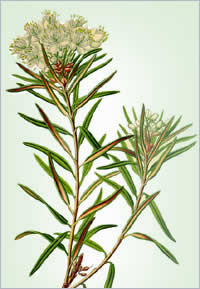
Marsh Rosemary

It may seem impossible, but at one time in this our world, all ale was made without hops. Beer was quite a different beverage back then. Brewers were still experimenting with large varieties of herbs, trying to find the perfect addition to their malty brews. Of the many differing herbs, it is documented that our brewing ancestors used wormwood, marsh rosemary, yarrow, nettle, sage, and more to make differently inebriating herbal beers. Now that we are living in the golden age of micro brews, brew masters all over the country have been experimenting with ancient recipes and ideas about what can make a good beer… but will hops ever be dethroned from the throne of well-loved beer ingredients?

Though it is little known, hops has not always been an ingredient for beer. In the 4,000+ year history of beer, the dominance of hopped ale has only taken place over the last 700 years or so. According to Stephen Buhner in his book Sacred and Healing Herbal Beers, one of the first uses of hops in ale was that of breweries in the Netherlands in the 14th century. Before hops took over the scene, the most popular beer was a brew known as Gruit. According to Buhner, Gruit contained many herbs that had opposite effects on the drinker than hops. Gruit ale allegedly stimulates the mind, increases sexual drive, and creates euphoria, whereas the effects of hopped ale cause drowsiness, and subdue sexual ability (even if the anti-inhibitatory effect of alcohol does cause more pick-up lines to be used).

It is doubtful that hops will ever be widely replaced by another herb, given the static tendencies of the world we live in, but there is still a market for ale without hops. Some people disdain the bitter taste hops add to beer, some dislike the sedative qualities of the plant, and a few are even allergic to hops. For this niche market, beer can be made entirely without hops. To make ale without hops, it is necessary to look at the properties that hops have that make them so ideal for brewing.

Hops have a lot of beneficial qualities for beer. Beside the flavor, which is well loved the world ‘round, the antibacterial qualities of hops helped greatly to keep ale from spoiling. This must have been a great benefit for brewers in the age before refrigeration. Curiously, the use of other herbs to help ale keep is well documented from before the age of hopped beer. So what caused the huge swing in favor of hopped ale?

Buhner links the rise in popularity of hopped ale with the Protestant movement’s anti-drug sentiments. Laws forbidding the herbs used in Gruit were among the first anti-drug laws passed into law. Little did the hopped beer advocates know at that time, but this protestant sentiment would eventually grow into the temperance movement and result in prohibition.

One ale without hops that is making a strong resurgence is Heather Ale. Heather ale is a Gruit-style ale being made with heather instead of hops. The re-introduction of heather ale started in the land of its origin, Scotland. Fraoch claims that heather ale goes back to 2,000 B.C., with a tenuous life on the fringes of society for the last 4,000 or so years. In 1986, home brew shop owner and brewer Bruce Williams found a recipe for heather ale translated from Gaelic, and has been mounting a crusade to re-introduce heather ale to the world ever since. Williams’ crusade has turned out to be quite effective. Fraoch has now become the first Gruit-style ale to go “international”, re-establishing a tradition which was almost eradicated from the world.

A Nutritional Guide to Beer

Beer has always been a source of nutrition for it’s drinkers.  The most common problem people have with beer is that it is too nutritious to be considered a mere beverage.  Beer is food, and must be considered as such in order for the avid beer drinker to maintain health.  Too much beer – just like too much food – and not enough exercise has been the downfall of many a beer fan.  The body of a beer has a great effect on it’s nutritional value, and so does the yeast used in the brewing.  First let’s look at some of the overall nutritional qualities of beer.

The most nutritious aspect of beer drinking is probably the least considered – not the malt, hops, barley, but the yeast.  Yeast sediment is uncommon in most commercially produced beers, but that doesn’t mean that the yeast isn’t there – it is.  Floating unseen in the body of the beer are the remnants of the magical creature that transforms sugar into alcohol.  Yeast remains accountable for the addition of B-complex vitamins, protein, and minerals to brews.  Most commercially produced beers have the yeast sediment rigorously strained out of it – but it is still there.  In “real ale” “live ale”, or “cask-conditioned” ales, you are likely to find a higher yeast content, as the beer is less processed.

One testament to the nutritious qualities of beer is the use of beer in certain food dishes.  In Belgium, a land where beers are many and varied, they make a dish called Carbonnade.  This is basically a beef stew, but it is made with beer instead of water!  Irish stew is another likely candidate to be spiked.  Beer is also found occasionally as a marinade (for kielbasas), as a moisturizer (beer can chicken), and is even claimed by some to tenderize meat.  I have even seen beer-based desserts on the menu at mid-scale restaurants – the most common being the Guinness Ice Cream Float.  Furthermore, the study “Effect of beer, yeast-fermented glucose, and ethanol on pancreatic enzyme secretion in healthy human subjects” conducted in 1996 suggests that the non-alcoholic part of beer, yeast fermented glucose, stimulates pancreatic enzyme production, helping the body to absorb nutrients from it’s meal.  It is likely that beer is not only nutritious, but also helps the body process other nutrients in the digestive system as well. 

Beer for desert, anyone?

To understand how beer can fit into our dietary regimens, let’s look at the nutritional qualities of a few types of beer.  Different makes of beer have different nutritional values, so we’ll have to be specific here.  We are going to select three champions from three different fields of brewing.  For the dark beers, we will choose Guinness as a popular representative.  For the amber ales, New Belgium’s Fat Tire, and for the Pale ales, Sierra Nevada’s Wheat Beer. 

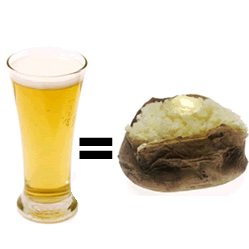
Twelve ounces of Guinness have roughly the same nutritional value as a baked sweet potato with no toppings: Sodium 20 mg. vs. 22 mg. in potato, carbs 10g vs. 12.4 g. in potato, and 40 calories worth of carbs vs. the 50 cal. sweet potato.  Guinness also has 82 cal. from alcohol (making a total of 122 cal.), and 0 g. fat, whereas the potato has 5 cal. of protein and 1 g. of fat.  As we can see, if you add a little butter, salt and pepper to the potato and the extra 4 ounces to the pint, they will come out roughly the same (although the potato will probably have more fat; the Guinness is actually quite lean).  This is a good way to look at the number of drinks you are having – a pint of Guinness is about like eating a lightly topped baked potato – but quite a bit tastier after the 2nd one.

New Belgium’s Fat Tire Amber Ale is well known for it’s full body and malty flavor.  All of that flavor does add up to more slightly more calories and carbs.  Fat Tire has a total of 155 calories and 14.7 grams worth of carbs, bringing it’s nutritional value up to that of a slightly larger baked sweet potato.  The good news is that you can easily work those extra calories off by bicycling to the bar and back!

Sierra Nevada’s Wheat Beer is a light-tasting alternative as far as beers go – but the flavors of this beer add up to more calories than Guinness!  With the same sodium content(20 mg.), and also more carbs (13.1g.), more protein (1.6g vs. Guinness 1g.), and more Alcohol 95 cal. than Guinness.  This goes to show that color isn’t everything.  Although Guinness is certainly the lightest beer, in terms of calories, from the field of Stouts.

We can see that different beers have a wide variety of nutritional values.  The one guideline I can suggest to figure out the nutritional qualities of your beer is that the more maltiness and body of the ale, the higher the caloric content is likely to be.  Keep all this in mind and keep a tally of the potato equivalent you are drinking each night.  This will help you to get the most out of your beer without getting too much!

A Guide to Mead

The mention of the word mead brings to mind images of fierce Nordic warriors at a feast hall consuming mutton.  In reality, mead is an ancient beverage, but a good quality mead is more like a fine white wine – a refined beverage.  The mixture of water, honey, and yeast, mead is a beverage that takes patience to brew.  The full fermentation cycle of a mead usually runs at about a year.  Bottling a mead sooner will usually endanger the bottle with explosion unless it is pasteurized.  On top of that, proper aging brings out even more of the subtle characteristics of the mead, making mead a prime candidate for collecting and aging.

When purchasing mead in the store, you should be careful to note the ingredients in the alleged “mead”.  Some companies produce white wine with just some honey added and call this “honey wine” or even “meade” – this is not mead, it is merely honey-sweetened wine.  Now, don’t get me wrong – there are many types of mead, including that made with grapes – but unless the honey has been fermented, it is not mead.  A simple addition of honey as a sweetener does not count.  Many people may still refer to a real mead as a honey wine as a descriptive term, however.

Many of the offshoots of mead are quite delectable, and no guide to mead would be complete without their mention.  There is cyser, which is a delectable combination of mead and hard cider.  This drink is especially enhanced by the addition of a bottle-conditioned piece of candied ginger on the bottom.  A little more savory than the worm in the tequila bottle, no?  Although, in this case, the cyser would also be a metheglin.  Metheglin is any kind of mead that has herbs or spices added, such as a mead flavored with clove, nutmeg, and cinnamon – which could be called a wassail metheglin I suppose.  This might be nice served hot!  The proper nomenclature for a cyser with such spices could be apple metheglin or simply spiced cyser.

One of the earliest ales was actually a mead.  Made first with honey and hops, later malt was added as an adjunct and eventually replaced the honey all together.  This kind of mead, or early ale is referred to as Braggot.  Another mead combination is that of honey and grapes, creating a kind of honey-wine mixture that is called Pyment, and either white or red grapes are used, depending on taste.  Some of the fine meads I have tasted are very similar to a fine wine, so I do not doubt that this combination is tasty.

There are many more possibilities, of course, but in any case where mead is mixed with fruit, the resultant drink may be referred to as Melomel.  This encompasses cyser, Pyment, and Morat (mead with mulberries).  The reason why so many meads have adjunct fruits is that yeast finds it difficult to take root in a true mead.  In addition to fruits and even grains and malt, some meads are made with the further addition of flower petals (could be considered a metheglin) such as roses, morning glory, and honeysuckle.

It is always possible for you to flavor your mead after buying it.  You can simply spice your mead for a mulled mead experience, add some candied ginger as recommended above, or even put a slice of apple or strawberries right in the bottle!  Allowing a month or so for these flavor to seep into your mead will greatly enhance the drink and personalize it, making for a fine gift idea or just to share with friends.  Mead is an exotic beverage as it is, but with your own special touch, it is sure to be a flavor to remember.

The Rebirth of the Speakeasy

If you are tired of paying $4+ for a beer at a bar, you aren’t the only one.  As more and more taxes are heaped upon drinks and transportation costs increasing dramatically, we are likely to see even steeper prices charged at the legitimate bar.  Most folks end up buying beer and drinking it at home or in the backyard, but there is something about the socialization that comes with going to the bar that a lot of folks can’t do without.  The point is having fun, not just drinking oneself into oblivion.  Still, to this day, there is indeed prohibition on many kinds of alcohol, such as absinthe.  So, naturally, the result of all this is the resurgence of the speakeasy.

My first experience with the modern speakeasy was one not unlike other bar experiences, but much enhanced exquisitely by the freedom of such a temporary autonomous zone.  The scene was similar to a house party, except that the home bar was exquisitely decorated in red and black velvet, bleached bones, and a kind of green haze in the air.  Naturally, smoking is allowed at such a speakeasy – another reason for the popularity of this event, as most states or big cities have outlawed smoking in bars.  The green was being reflected off of the bottles of Absinthe lining the walls and the milky green drinks being sipped by those in attendance, dressed in either black lace or leather, almost exclusively it seemed.  I was in the leather crowd.

Event, you say?  Yes, by necessity, the modern speakeasy is an event, not a place.  Or rather, a place that is recreated in a different location each time.  It seems that those “in-the-know” were the only ones there, and that the main way people found out about the speakeasy was word of mouth.  Usually the location is kept secret until the night before the event, and then word spreads quickly.  The speakeasy usually doesn’t even open until after other bars are closed, sometime after 2 AM.   All these are signs of a truly underground party scene.

The modern speakeasy will usually have many varieties of home brewed beverages available.  Among the beers I have seen are a raspberry porter and a pale ale, and even mead was available on tap.  The beverages are usually served chilled, from the spout of a homemade kegerator conversion.  Absinthe is sometimes available, either tidy or traditionally mixed with water and sugar.  I like both versions, and I may go in for the stronger stuff as the night progresses.  The exciting thing about the traditional absinthe is that it is served with a live flame on top of the glass, and you must blow it out before drinking – this is reminiscent of an episode of the Simpsons where Homer brews a similarly combustible drink – the “Flaming Homer”.  Straight absinthe is not recommended for anyone but those who have iron gullets and enjoy EXTREMELY bitter flavors.

I have been pleased with the cleanliness and order of the speakeasies I have visited – there is always a bar back to wash glasses and the drinks are nicely displayed.  There were a number of liquors lining the back of the bar at the first speakeasy I went to, and not only were they green, but also clear, blue, yellow, and golden brown.  I was only to find out later about some of these bottles, when I happened upon this same speakeasy again.

The speakeasy bar was nicely built and accessorized.  Plenty of pint glasses and specialty glasses were available for the absinthe, something like a large brandy snifter.  Towels, napkins, and peanuts were all available as well.  Other home bar speakeasies I have encountered have been much cruder than this set-up, merely with Cornelius kegs a-float in ice, with plastic cups.  More of a large crazy party scene.  One thing you can count on with these home bar speakeasies is that the barkeep will have something special under the table.  At times I have found t to Absinthe, Mugwort Liqueur, or Anise Liquor, so if you find yourself at one, you should ask about any specials available.  It was in this manner that I first tasted a truly fine whisky – a rare treat, but still cheap at $10 a shot.  The sweetness of it put it in a whole other category from what I had ever tasted before, and it had a kind of oily taste, hinting of vanilla, that only brought the term “snake liquor” to mind… and I could see why whisky got its reputation.

If you are eager to attend a home bar speakeasy, I recommend keeping your ears open and exploring different party scenes.  You just might get the tip off that will greatly enhance your night.  Or, barring that, why not build your own home bar?  That way, you can enjoy all the benefits of a speakeasy without the potentially nasty legal implications.  And as always, drink in good health.