Keg registration is a controversial law going on the books around the country, at a state level. Keg registration is a process
by which kegs and taps are affected by an additional tax and tagged so that they can be traced. Allegedly, this tagging process
allows authorities to curb underage drinking. According to the Alcohol Policy Information System, a project of the National
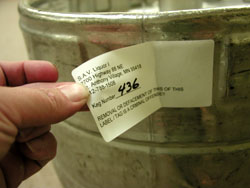
Institute on Alcohol Abuse and Alcoholism, keg registration laws "require wholesalers or retailers to attach a tag, sticker, or
engraving with an identification number to kegs exceeding a specified capacity (two to eight gallon minimum depending on the
State)". The tags are signed out with the buyers name, address, and state ID number so that if officers are able to bust a keg
party where underage drinking is observed, they are able to trace the kegs easily back to the purchaser.
 |
Keg sellers have quibbled all over the country when they see the keg registration laws coming. It is a hassle for the average
keg seller to have to write down the address and ID number from everyone who buys a keg from them, and the additional tax is a
burden they do not relish. Politicians and police authorities relish the idea, of course, as a way to maintain any further amount
of control over the flow of alcoholic beverages and flex their muscle.
While, in theory, the keg registration should allow authorities to track down the buyer of kegs found at parties with underage
drinking present, there have been few if any reports of this law working to curb underage drinking.
According to College newspaper the Daily Iowian earlier this year (7/15/08):
A keg-registration law passed in 2007 apparently has yet to be effective in combating underage drinking. One year
after the measure became law, many in Iowa City have felt no effect. "I know of someone who purchased six kegs for a couple
underage parties [last] fall," said UI graduate Claire Goldenberg, 22. "It's not stopping anything."
After much research, the only report found was about some fellows who stole kegs off of a person's porch and tried to
erroneously claim the deposit for the kegs. The shopkeeper ended up being suspicious, and when the ID numbers didn't match, he
called the police who foiled the deposit stealing scam. As reported in the Daily Iowian 7/15/08:
"...when two middle-age men strolled into the Liquor House in October 2007 in hopes of cashing in the nine empty kegs
they carried, the law proved to be useful. Rather than leaving with money in hand, the men left with their hands in cuffs. The
men had allegedly stolen the empty kegs off the porch of the original purchaser", Uthe said.
"When [the two men] returned the kegs for cash, and their IDs didn't match the stickers on the kegs, we called the
cops," he said.
Recently, the invention of disposable kegs has thrown a monkey wrench into the works of keg registration. Disposable kegs
represent a complicating factor. Some of these units meet the state laws' definition for a keg, but they can not be easily traced
because the units are meant to be disposed of after use.
So far, keg registration laws have been passed in 26 of 50 states. See if your state is on the list: Arkansas, California -
seven or more gallons, Connecticut, Georgia, Idaho, Indiana, Kansas, Maryland, Massachusetts, Michigan, Minnesota, Missouri,
Montana, Nebraska, New Hampshire, New Mexico, New York, North Carolina, North Dakota, Ohio, Oregon - six or more gallons, Rhode
Island, South Carolina, Vermont, Virginia, Washington - four or more gallons. The state of Utah has no keg registration laws as
such. Utah requires anyone in possession of a keg containing more than 2 liters to have a temporary beer permit, and limits the
use of kegs to light beer only.

Komos
 Summit
 Beverage-Air
 DCS
DCS
 Marvel
 Perlick
 Bull
Bull
 Avanti
 Danby
Danby
 CM Becker
 Continental
 Fagor
Fagor
 Cal Flame
 Twin Eagles
 Frigidaire
 Fire Magic
 GrowlerWerks
 Hestan
 Igloo
Igloo
 True
True
 Intertap
 Kegco
Kegco
 Keggermeister
 Koolatron
 KegLand
 Krowne
 Krups
Krups
 Lynx
Lynx
 Maxx Cold
 Micro Matic
 Midea
Midea
 Nor-Lake
 Nostalgia
 Arctic King
 Synek
Synek
 Taprite
 Turbo Air
 UBC Group
 Value Series
 Versonel
 VinoTemp
 New Leaf


