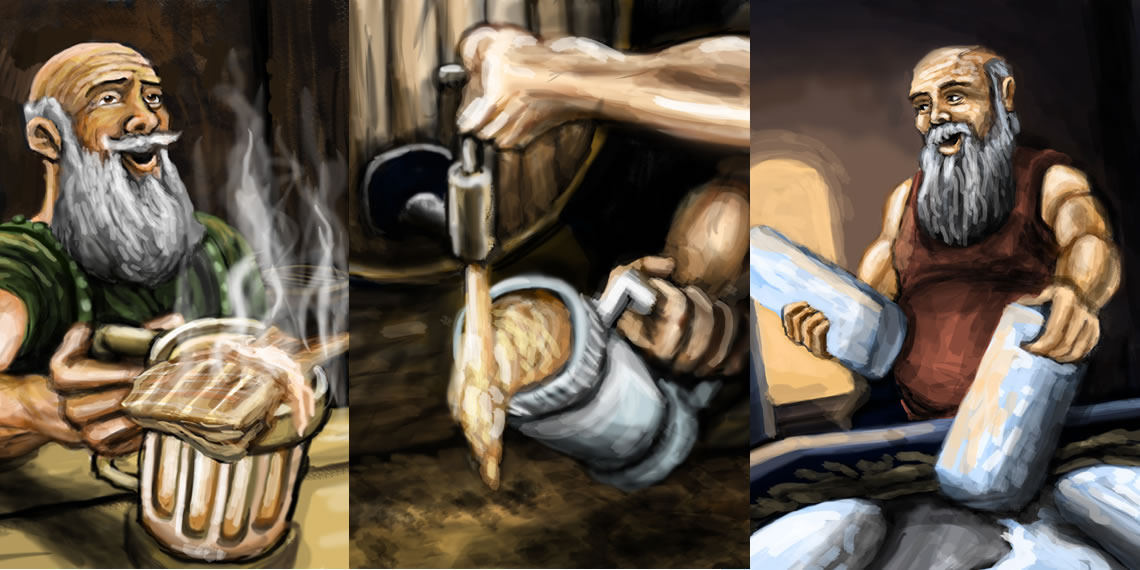
While the origin of the kegerator seems to be veiled in the mists of D.I.Y. (Do It Yourself) skill sharing, it is likely that the very first kegerators were put into operation in the early 1900's. This is a time when refrigerators were first being made commercially available in industrialized societies, and before prohibition in the United States. Pubs and saloons were probably the first places where beer was kept in refrigerator units such as walk-in cold rooms. It is likely that for the period from about 1890-1919 (when prohibition started) that draught beer was served alongside refrigerated cask ale.
Of course, the only place one was likely to find new-fangled refrigerators, let alone kegerators, was likely to be at the hub of innovation: urban areas. About the time that prohibition was enacted in the United States, beer was still legal in the U.K., although the country had other problems: war. One could surmise that shortly after WWI had ended, when prohibition was still enforced in the United States, the kegerator was being used to chill Guinness in the U.K., while in the states the soda fountain was doing the same for soft drinks. As many home brewers know, the two inventions have a lot in common.
The soda fountain was invented by a pharmacist named Jacob Baur. He established the Liquid Carbonic Company in 1887 and was manufacturing soda machines for drug stores as well as factory models for those with bigger soda ambitions in the early 1900's. This was a pivotal period for the way people thought of beverages, as the rate of technological advancement was proceeding rapidly.
The appearance of canned beer in the early 1900's in all likely-hood conditioned the American people more and more towards the drinking of highly filtered and pasteurized beer. The coming era of prohibition probably enforce this beverage paradigm even more, as clean cut soft drinks were taken with meals by many folks instead of beer. As to the drinkers, the profit of illicit speakeasies lay more in the hardest stuff, spirits that were concentrated and easier to smuggle than a barrel of beer. So when beer was made legal again in 1933, even though in the midst of the great depression, the technological groundwork was laid for the emergence of the early kegerators.
It didn't take long for the beer industry to regain its footing. Beer in a can was already appearing, and most folks soon started to drink their beer from a can in the following years. Canned beer first came out in January of 1935 from the Kruger Brewing Company of Richmond, VA, under the title "Kreuger Cream Ale". Many companies, such as Pabst, labeled their canned beer differently, fearing that something might go wrong with the beer as it sat in cans. Within a matter of years, however, these fears were assuaged by the ease of production and efficiency of transport. Within one year of the repeal of prohibition there were 756 brewers back in operation. By 1940 Beer production was back up to the level that it was before prohibition, and with half the number of breweries in operation as were operating in 1910. In one sense, beer was back, big time. But in another sense, much of the quality of the craft brewery was missing. It would take another 40 years before the craft beer revival would make itself evident in America.
From a historical viewpoint, it is easy to see how the first kegerators for home use probably didn't appear until after World War Two. From prohibition to Depression to War, the American economy had little time for such seemingly frivolous activities as making kegerators. By most accounts, it seems that the resurgence of home brewing brought the kegerator into many homes.
 Continue to Part Eight: The Resurgence of Home Brewing and the Kegerator

Komos
 Summit
 Beverage-Air
 DCS
DCS
 Marvel
 Perlick
 Bull
Bull
 Avanti
 Danby
Danby
 CM Becker
 Continental
 Fagor
Fagor
 Cal Flame
 Twin Eagles
 Frigidaire
 Fire Magic
 GrowlerWerks
 Hestan
 Igloo
Igloo
 True
True
 Intertap
 Kegco
Kegco
 Keggermeister
 Koolatron
 KegLand
 Krowne
 Krups
Krups
 Lynx
Lynx
 Maxx Cold
 Micro Matic
 Midea
Midea
 Nor-Lake
 Nostalgia
 Arctic King
 Synek
Synek
 Taprite
 Turbo Air
 UBC Group
 Value Series
 Versonel
 VinoTemp
 New Leaf