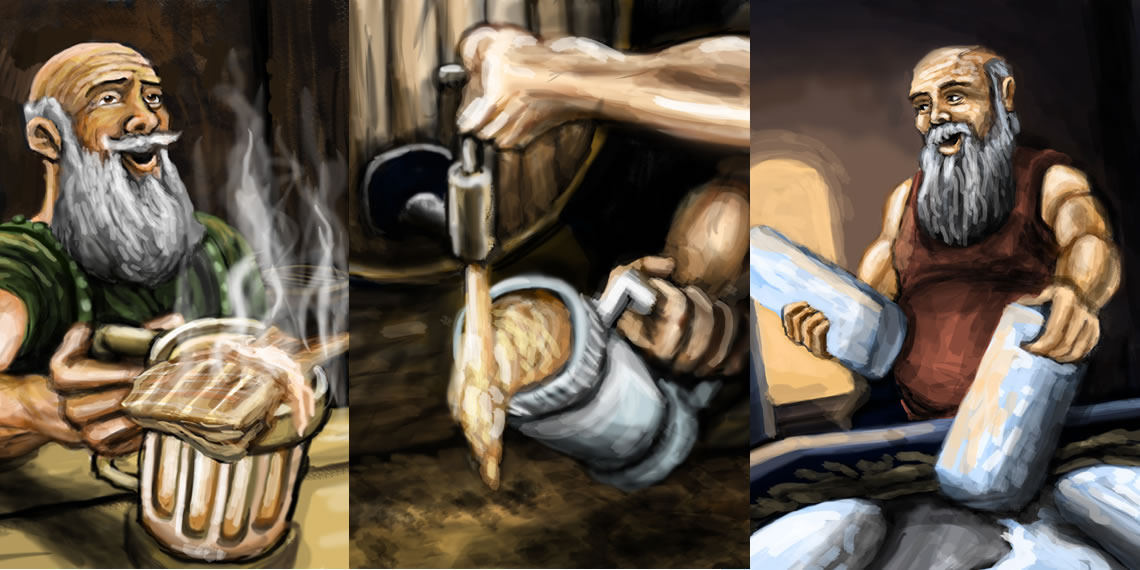
We will take a step back now, and examine the evolution of the draft beer system. There are reports of beer draft systems being invented as early as 1691. According to the London Gazette of 1961, of a certain John Lofting:
"The said patent owner has also projected a very useful engine for starting of beer, and other liquors which will draw from 20 to 30 barrels an hour, which are completely fixed with brass joints and screws at reasonable rates."
But it was Joseph Bramah that patented the beer engine in 1785. This was an air pump system which brought the beer forth from a keg. I have seen similar systems used by home brewers today - but usually a bicycle tire pump is used with a special fitting for a Cornelius, or soda keg. I doubt that many of these home brewers have heard of Bramah's patent, however, his beer engine served beer around the globe until the last decades of the 19th century. It was at this time that pressurized ales began to make their appearance, replacing cask ales and Bramah's beer engine dramatically. By 1900, 75% of ales in the United States were being served with pressurized gases.
Until the advent of stainless steel and aluminum kegs, all beer was packaged in wooden kegs. Both these wooden kegs and their metallic descendants were, and still are often coated on the inside with a natural wax or resin to prevent contamination of the barrel and the beer. It is curious to note that many beer traditionalists still to this day prefer a cask ale, one that is poured with gravity straight from the cask, to an artificially carbonated ale.
Draught beer was served pressurized by the early 1900's, and gas separation and compression technology was catching up to the beer world. Force carbonation came about first in England in 1936. Watney's Red Barrel was one of the first beers that came artificially carbonated and pasteurized. This kind of beer was not popular in England then, but became the standard for the rest of Europe, known as beer "en pression". Artificially carbonated and pasteurized beer became increasingly more common through the 1970's, and has been the standard ever since.
Natural beer aficionados in England established the Campaign for Real Ale (1971) to advocate for un-pressurized beer, and came up with the term "real ale" to define beer served from the cask from beer served under artificial pressurization. Eventually, the term "real ale" was expanded to include bottle-conditioned ales, and now the term "cask ale" is used to refer to un-pressurized ales.
With the move to colder and colder beer came naturally the progression of beer that was more and more carbonated. Because CO2 dissolves more easily into liquids at colder temperatures, the movement towards colder beer meant a move towards more carbonated beer.
The beer keg, as we know it now, came into being in the early 1960s. The design allows efficient cleaning and filling in the brewery, with a downspout located in the middle and a valve that both allows beer in and gas out and vice-versa. A standard US keg holds:
- 15.5 gallons, or
- 58.67 liters, or
- 100 British pints, or
- 120 US pints, or
- 164 12 oz drinks
Before the standard beer keg came along, the "cask" that contained beer usually had straight sides and a flat bottom. The changes made in the modern keg of being more rounded tend to prevent as much sediment from forming. By the same token, these kegs are designed for beer that is thoroughly filtered and pasteurized, and so they are not designed to be scrubbed free of yeast sediment. Still, some home brewers have been using these standard beer kegs for their home brew with much success, and most kegerator systems are easily adaptable to the standard beer keg.
 Continue to Part Seven: Early Kegerator Era

Komos
 Summit
 Beverage-Air
 DCS
DCS
 Marvel
 Perlick
 Bull
Bull
 Avanti
 Danby
Danby
 CM Becker
 Continental
 Fagor
Fagor
 Cal Flame
 Twin Eagles
 Frigidaire
 Fire Magic
 GrowlerWerks
 Hestan
 Igloo
Igloo
 True
True
 Intertap
 Kegco
Kegco
 Keggermeister
 Koolatron
 KegLand
 Krowne
 Krups
Krups
 Lynx
Lynx
 Maxx Cold
 Micro Matic
 Midea
Midea
 Nor-Lake
 Nostalgia
 Arctic King
 Synek
Synek
 Taprite
 Turbo Air
 UBC Group
 Value Series
 Versonel
 VinoTemp
 New Leaf