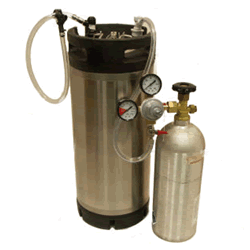
Kegging your own beer is an effective way to store and serve home brew to your community. Kegging beer is not a difficult task, but it does require a little know-how. Kegging your home brew actually saves quite a bit of time compared to bottling your beer. This is especially true if you are kegging into a larger Sanke keg, because you get three times as much beer in your keg vs. a smaller Cornelius keg.
Getting Started
First, we will go over the process of kegging beer in a standard soda keg, also known as a Cornelius keg. The first thing to do is to clean and sanitize your keg. Make sure the keg is de-gassed before you start, by pulling the emergency release valve on the top of your soda keg's lid.
After removing the pressure, you should find it easy to pop the lid off. Now start cleaning and scrubbing - this is usually done by using a bottle brush to scrub the keg very thoroughly and then sanitize the keg with an Iodophor solution. Make sure that you pull out the liquid feeder tube and clean that as well as check the o-rings on your fittings. Give the keg one good last rinse with clean cold water and then pressurize it with CO2 to drive the regular air out. Now your keg is ready for beer, and will keep much better over the course of a few days if you must delay your kegging process, thanks to the CO2 filler gas.
Pressurizing the keg with CO2 will also help you to locate problem areas where the keg has worn seals and o-rings. If you have any problems maintaining your pressure, you will want to fix that or your beer may become tainted or leak out. Most brewing supply stores carry kits of o-rings to re-condition your corny keg with, but you can easily get replacements at Kegerators.com.
If you have acquired a larger Sanke keg, you are ready to begin making beer in bulk. Again, the first effort is to clean the keg out thoroughly. At first glance, this seems more difficult than cleaning a Cornelius keg, but really, it is much the same. Opening the Sanke keg is simple if you know a few tricks. All you really need are a few tools to do it.
First, like with the Cornelius keg, you must de-gas the keg. This is done with a crescent wrench. A size around ¾ inch should work. You should take your Sanke keg outside before attempting this, as a gush of stale beer may ensue. Now, lay the keg on its side, and, straddling the keg, use the wrench as a lever on the ball valve to press it down. You can anchor your wrench's crescent end inside the lip of the tap hole on top of the keg, and where the wrench presses against the ball valve will be the fulcrum of your lever.
After de-gassing the keg, collect a pair of needle-nosed pliers and a medium-sized flathead screwdriver. With these tools and some tinkering around, you can extract the coil spring, which is the only thing holding the ball valve and spear into the keg. The key is to use the screwdriver to nudge the spring around until you can get in where the lip gap is to pry it inward. Then, you can grab it with the pliers and pull it out. Be gentle with the spring and ball valve, you will want to keep them in good shape.
Cleaning is a little harder, because it is not so easy to get the bottle brush in there. We recommend filling the keg with water and just boiling it for 20 minutes as a starter. See what you can do with the bottle brush and then give it the sanitizing solution, cold water rinse, and CO2 fill.
Carbonation
Kegging your beer gives you a few options as to carbonation. You can naturally carbonate your beer by putting it in the keg near the end of the fermentation cycle, but before it has finished fermenting. This will give your beer a more natural taste, but takes a good sense of timing to ensure that your carbonation efforts will be successful. Most home brewers choose to put the beer in with dry corn sugar or malt extract to provide the sugar boost needed for carbonation.
You can always feel safe force carbonating your beer. This is done by pumping up the pressure in the keg to around 30 PSI and rolling the keg gently to mix the solution of CO2 and beer. You can leave this mixture overnight, but remember to let off the excess pressure after a few hours by pulling the pressure release tap on your keg. Leave the pressure at a normal serving level (around 7 PSI) for a week and your beer should be nicely carbonated without foaming.
Remember to keep those tap lines clean in between each keg. Now you are ready to move forward with serious keg drinking!

Komos
 Summit
 Beverage-Air
 DCS
DCS
 Marvel
 Perlick
 Bull
Bull
 Avanti
 Danby
Danby
 CM Becker
 Continental
 Fagor
Fagor
 Cal Flame
 Twin Eagles
 Frigidaire
 Fire Magic
 GrowlerWerks
 Hestan
 Igloo
Igloo
 True
True
 Intertap
 Kegco
Kegco
 Keggermeister
 Koolatron
 KegLand
 Krowne
 Krups
Krups
 Lynx
Lynx
 Maxx Cold
 Micro Matic
 Midea
Midea
 Nor-Lake
 Nostalgia
 Arctic King
 Synek
Synek
 Taprite
 Turbo Air
 UBC Group
 Value Series
 Versonel
 VinoTemp
 New Leaf