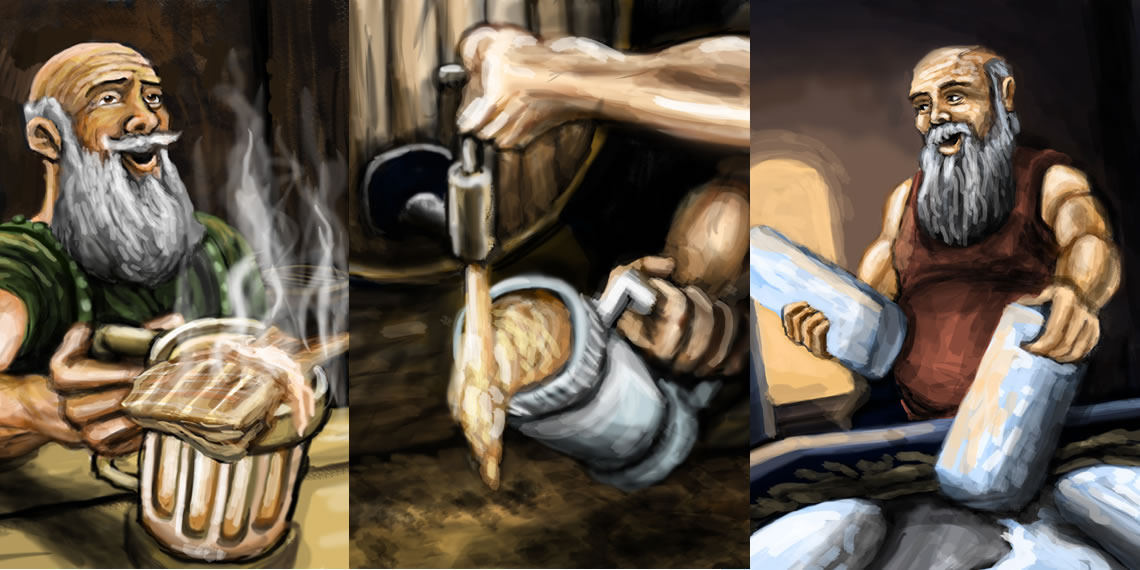
In the days of early refrigeration around the 1850-1900s, the cold air engine was only beginning to emerge. The way most folks kept things cold was with ice in a basement lined with straw for insulation... ice had to be imported from cold regions, and ice houses held massive and melting blocks for the public to buy and haul away to their basements in iceboxes that were very different from the iceboxes we think of today. Although you can see the evidence of the connection between beer and icehouses still.
Fortunately, for the beer barons, the advancement of refrigeration technology began to accelerate at this time. In fact, it was the same year that the first American Lager was brewed, in 1842, that an American physician, John Gorrie, designed the first system for refrigerating water to produce ice. His system was a failure commercially, but his research paved the way for others. By 1856 refrigerating systems began to be commercially produced.
The vapor compression refrigeration systems were among the first to be used in commercial breweries. By 1861 a dozen on these systems, invented by Alexander Twining, were in operation in both breweries and meat packing houses. The next phase was the Frenchman Ferdinand Carre's aqua ammonia system of manufacturing ice. Building or working with refrigeration during the late industrial revolution could be considered a very dangerous line of work. All of this was brand new technology, and the kinks weren't really worked out until the invention of Freon as a coolant. Before this, highly pressurized units piping dangerous, mostly deadly chemicals such as Ammonia, sulfur dioxide, and ethyl ether were leaking vapors and gases that would jeopardize the health of workers.
Some brewers still used ice to lager their beer at this time. Adam Lemp, of St. Louis, is one example of a fellow with an interesting solution to lagering. His problem was a limited space with which to store his beer during the lagering process. His solution was to utilize a newly discovered natural limestone cave, located just south of the city (now it is at the northwest corner of Cherokee and De Menil Place). The cave's temperature was controlled by ice chopped from the Missouri River and over 3,000 barrels of beer had been aged in that cave during its first year of operation as a warehouse...
Breweries had become the largest users of commercial refrigeration units by the 1870's. Some brewers, such as Thomas Lemp and his lagering cave, still relied on ice harvesting. The ice-harvesting industry was starting to have troubles, however, with sanitation: sewage and pollution had begun to make itself evident in natural ice. This became a problem in the metropolitan areas, and eventually breweries that still relied upon ice harvesting had to turn to applications of the new refrigeration technology. In turn, the new amount of capital invested into such technology produced more modern and consumer level refrigerators and icemakers.
Meanwhile, freight cars were being developed that used air-cooling and ice boxes to ensure coolness in the car during transport. The combination of new technologies from an array of fields made national marketing of beer and other perishable products possible at a scale unknown before hand. In 1895 a process for the large-scale production of liquid air was developed, making refrigeration safe for the home, finally. Eventually paving the way for liquid oxygen for use in household refrigerators, thanks to the inventions of Carl von Linde.
We can see that all these trends culminated in what is now perceived to be the standard in real ale appreciation: the draft ale. One can surmise that by 1900 one could enter most common houses in the western world and receive a pint of draft beer similar in character as one could today: chilled, served from a keg (most likely still a wooden keg back then), pressurized, carbonated, and with a nice head about it. One of the biggest differences is that in the modern age, this fine, full draft beer experience can be had in your own home, with a kegerator.
 Continue to Part Four: Beer Barons and Cold Beer

Komos
 Summit
 Beverage-Air
 DCS
DCS
 Marvel
 Perlick
 Bull
Bull
 Avanti
 Danby
Danby
 CM Becker
 Continental
 Fagor
Fagor
 Cal Flame
 Twin Eagles
 Frigidaire
 Fire Magic
 GrowlerWerks
 Hestan
 Igloo
Igloo
 True
True
 Intertap
 Kegco
Kegco
 Keggermeister
 Koolatron
 KegLand
 Krowne
 Krups
Krups
 Lynx
Lynx
 Maxx Cold
 Micro Matic
 Midea
Midea
 Nor-Lake
 Nostalgia
 Arctic King
 Synek
Synek
 Taprite
 Turbo Air
 UBC Group
 Value Series
 Versonel
 VinoTemp
 New Leaf